

Gain Control Through Psychotherapy
What is OCD (Obsessive-Compulsive Disorder)

Obsessive-Compulsive Disorder (OCD) is a cycle of intrusive thoughts and repetitive behaviors that feel impossible to ignore. The relief of completing that action is short-lived, which keeps the cycle going. OCD is not about being neat or particular, it’s about feeling trapped by doubt and fear.
If you’re in Purpleville, Kleinburg, or in the surrounding area, visit us to get OCD therapy in Vaughan. Our evidenced based approach interrupts the cycle, so thoughts lose their power and compulsions no longer control you.
Book an Appointment101 Psychotherapy – Always caring, always here
Manage Your Compulsive Tendencies
OCD Behaviour
Obsessive Thoughts
Obsessions are intrusive thoughts, images, or urges that feel unwanted and uncontrollable. They don’t align with your values, yet they demand attention as if they signal real danger. These thoughts create a sharp spike of anxiety, guilt, or fear, not because you want them, but because they feel so disturbing and persistent.
Symptoms Include:
Fear of contamination: Worry about germs, illness, or spreading harm to others.
Excessive doubt: Persistent uncertainty about whether something was done “correctly” or safely.
Need for symmetry or exactness: Intense discomfort when things feel uneven or incomplete.
Intrusive aggressive thoughts: Disturbing images of causing harm, despite no desire to act.
Religious or moral fears: Obsessions about sinning, offending, or being immoral.
Unwanted sexual thoughts: Distressing thoughts that conflict with personal identity or values.
Compulsive Behaviours
Compulsions are repetitive actions, physical or mental, performed to reduce the anxiety triggered by obsessions. They provide temporary relief, but that relief reinforces the cycle, making the urge stronger next time. Over time, rituals can become rigid, time-consuming, and exhausting. Many people recognize the behaviors as excessive, yet feel unable to stop because the fear of “what if” feels too powerful.
Symptoms Include:
Repeated checking: Verifying locks, appliances, or messages multiple times.
Excessive washing or cleaning: Rituals meant to neutralize contamination fears.
Mental reviewing: Replaying events to ensure nothing inappropriate happened.
Counting or repeating phrases: Performing actions until they feel “just right.”
Arranging and ordering: Reorganizing items to reduce internal tension.
Seeking reassurance: Repeatedly asking others for certainty or validation.
Our Process
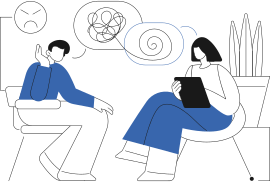
step 1
Initial Consultation
We listen to your concerns and understand your needs.

step 2
Personalized Plan
Together, we create a tailored therapy approach that fits you.

step 3
Therapy Sessions
Compassionate, evidence-based sessions to support healing.

step 4
Progress & Support
We track improvements and adjust strategies for lasting well-being.
Improve With Our OCD Therapy
OCD Treatment That Works
OCD is maintained by a repeating pattern, an intrusive thought triggers anxiety, anxiety leads to a compulsion, and the brief relief from the ritual strengthens the obsession. Our Vaughan psychotherapy office focuses on interrupting this pattern in a structured, evidence-based way.
Treatment is not about reassuring you that your fears aren’t real, and it’s not about forcing thoughts away. It’s about helping you tolerate uncertainty without responding with rituals. As part of our OCD therapy in Vaughan, we work gradually and strategically so anxiety decreases naturally and compulsions lose their grip over time.
Our Therapy Methods for OCD
Cognitive Behavioural Therapy (CBT)
CBT helps you examine the beliefs attached to intrusive thoughts and challenge the meaning you’ve assigned to them. This weakens the fear response and reduces the urge to neutralize the thought.
Exposure Response Prevention (ERP)
ERP involves carefully planned exposure to feared thoughts or situations while resisting compulsive behaviors. With repetition, your brain learns that anxiety fades on its own without rituals.
Acceptance and Commitment Therapy (ACT)
ACT teaches you to allow intrusive thoughts to exist without engaging with them. You develop the ability to move toward valued actions even when discomfort is present.
Mindfulness
Mindfulness builds awareness of thoughts as mental events rather than threats. This reduces reactivity and creates distance between the obsession and your response.

Benefits Of OCD Therapy
Less compulsive behaviors
Learn strategies to respond to intrusive thoughts without acting on them, breaking repetitive cycles over time.
Less anxiety from intrusive thoughts
Develop tools to tolerate uncertainty and distress without letting obsessions take over your day.
Improved focus and productivity
Freeing your mind from constant rituals allows more mental space for work, relationships, and daily tasks.
Healthier emotional regulation
Build resilience to stress and learn to respond calmly rather than reacting to obsessive urges.
Better quality of life
Reduce the time, energy, and emotional strain consumed by OCD patterns, making space for enjoyment.
Stronger coping skills
Equip yourself with techniques to handle future challenges without falling back into obsessive-compulsive cycles.
Break Free from Compulsions – Begin Your OCD Support Journey
Visit us for OCD Therapy In Vaughan
What Information for Our Clients
Frequently Asked Questions
Can my OCD subtype switch over time?
Yes, OCD subtypes can shift as life circumstances, stress, or triggers change. Someone might start with checking behaviors and later experience contamination fears or mental rituals. Therapy helps manage symptoms regardless of subtype.
Why do subtypes matter?
Understanding your OCD subtype helps tailor treatment. Different subtypes respond best to specific strategies, like targeted Exposure and Response Prevention (ERP), so therapy can be more effective.
What is the difference between obsessions and compulsions?
Obsessions are intrusive, unwanted thoughts, images, or urges that create anxiety. Compulsions are the behaviors or mental rituals performed to reduce that anxiety, even if temporarily.
How common is it to have OCD?
OCD affects roughly 1-2% of the population, and many people experience mild obsessive or compulsive tendencies without a formal diagnosis. It’s more common than people realize, and effective therapy is available.
Is OCD a brain disease?
OCD involves differences in brain circuits related to decision-making, error detection, and anxiety, but it’s treatable. Therapy and sometimes medication help rewire patterns, making symptoms manageable.
A Safe Space for Healing, Balance and Growth.
Book an Appointment With Our Psychotherapist Today!
Take control of your life with OCD therapy in Vaughan. Our experts provide guidance, support, and practical tools to reduce compulsions and restore balance.