
In this article
High-functioning depression does not look the way most people picture depression. You are not in bed. You are not crying every day. You go to work, manage your responsibilities, and appear, from the outside, completely fine. Inside, something is consistently off. There is a flatness that does not go away. A background effort required just to stay level that most people around you do not seem to feel. You function, but it costs more than it should. This is high-functioning depression, and it is more common than most people realize.
What high-functioning depression actually looks like
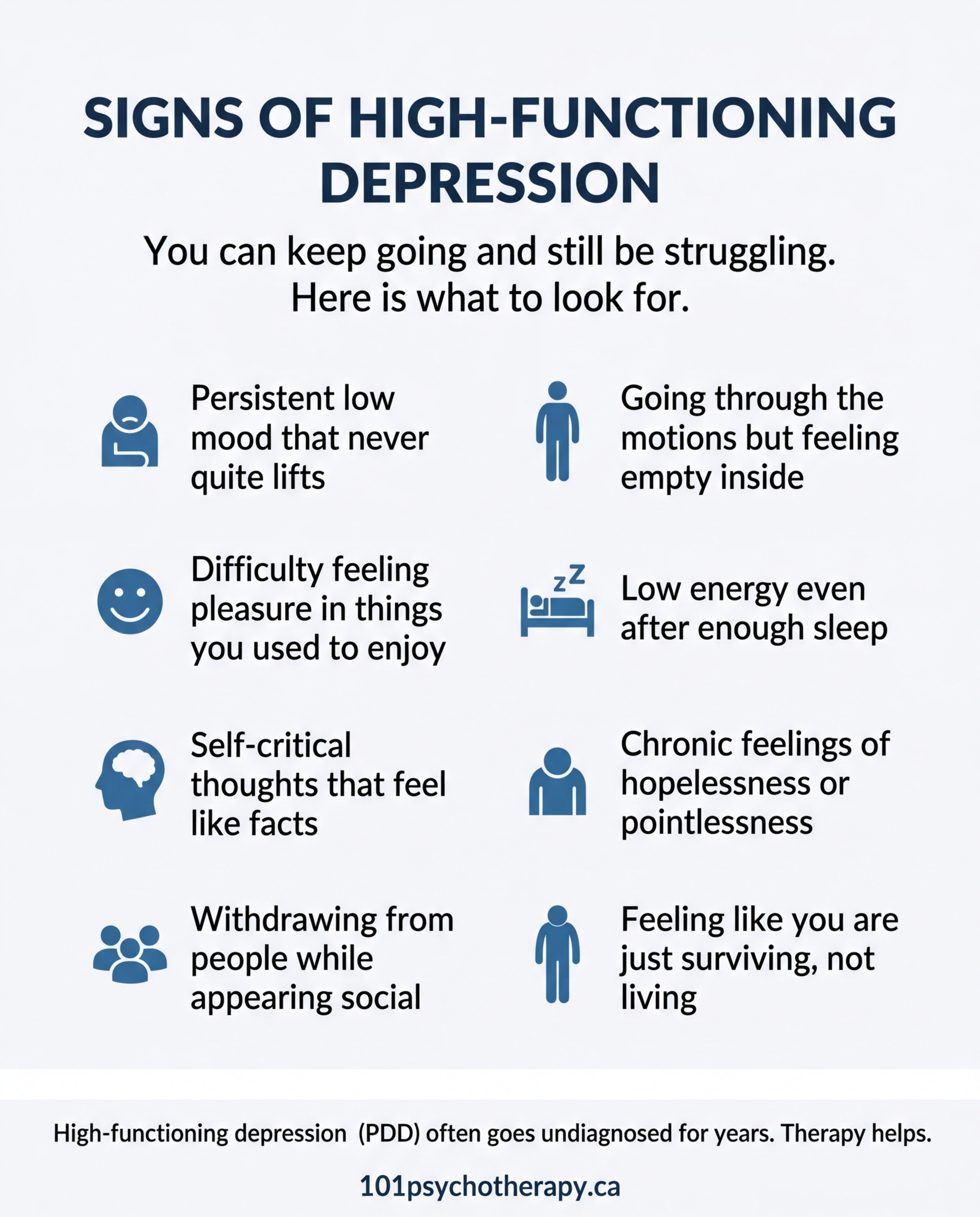
Because you are keeping up with life, high-functioning depression rarely gets named as such. The signs are quieter than a full depressive episode. They are also easier to explain away or dismiss. Common patterns include:
- A persistent low mood or emotional flatness that has lasted months or years
- Going through the motions without feeling genuinely present or engaged
- Difficulty remembering the last time you felt genuinely happy or energized
- Low energy even after enough sleep
- Self-critical thinking that feels like fact: I am not doing enough, things will not improve, this is just who I am
- Gradual withdrawal from people while still appearing engaged
- A vague, persistent sense that life is less than it should be
None of these are dramatic. That is partly why they go unaddressed for so long.

People often ask: Can you have depression if you seem fine on the outside?
Yes. High-functioning depression is exactly this: maintaining outward productivity and social engagement while privately experiencing depressed mood, low motivation, chronic fatigue, and reduced enjoyment. It's well-documented in clinical settings and one of the main reasons depression goes unrecognised for years.
Why high-functioning depression often goes undiagnosed for years
When depression is not impairing your ability to function, neither you nor anyone around you is likely to flag it as a clinical concern. You hold it together. You produce results. From the outside, there is nothing to worry about. Internally, you often adapt. The low mood starts to feel like your baseline. You stop expecting to feel better because the current state has become familiar. Some people spend 10 or 15 years in this adapted state before anything prompts them to seek help. Clinically, this pattern often corresponds to Persistent Depressive Disorder (PDD), formerly called dysthymia. It is a real diagnosis in the DSM-5, defined by a low mood persisting for at least two years in adults, accompanied by at least two of: poor appetite or overeating, insomnia or oversleeping, low energy, low self-esteem, poor concentration, or hopelessness.
Did you know?
Research published in JAMA Psychiatry found that persistent depressive disorder (dysthymia), a common form of high-functioning depression, goes undiagnosed for an average of 7 to 10 years. The condition responds well to therapy, yet most people living with it have never received a formal diagnosis.
The cost of leaving it unaddressed
Persistent low-grade depression has real consequences even when you are still functioning. Research shows it is associated with higher rates of relationship dissatisfaction, reduced work performance over time, increased physical health complaints, and higher vulnerability to a full depressive episode when a significant stressor hits. The longer it goes unaddressed, the more entrenched the patterns become. Negative self-talk that has been present for five years is harder to shift than negative self-talk of six months. Getting help earlier is not just faster, it is more effective.

What therapy actually does for this kind of depression
Cognitive Behavioural Therapy (CBT) is particularly well-suited to persistent depression. It targets the two main maintaining factors: the thinking patterns (chronic self-criticism, hopelessness, low expectations) and the behavioral patterns (withdrawal, reduced activity, decreased engagement). Behavioral Activation, a core component of CBT for depression, works by gradually rebuilding engagement with activities that provide a sense of accomplishment or pleasure. This is not about forcing positivity. It is about breaking the cycle where low mood reduces activity, which reduces positive experience, which deepens the low mood. ACT-based approaches help with the hopelessness and acceptance patterns that come with long-term depression. They focus on clarifying what matters to you and building a life around it, rather than waiting to feel better first. Many people also benefit from medication alongside therapy, particularly when the depression has been present for years. A conversation with your family doctor is a useful starting point.
When to take it seriously
If you have felt this way for most of the past two years, that alone is reason enough to talk to someone. You do not need to be in crisis to deserve support. The threshold for therapy is not hitting rock bottom. It is recognizing that how you feel now is costing you something, and that it does not have to stay this way.
Our therapists at 101 Psychotherapy specialize in depression, anxiety, and burnout. We serve clients in Vaughan, Richmond Hill, Aurora, Brampton, and online across Ontario. Book a free consultation.
Frequently asked questions
Is high-functioning depression a real diagnosis?
High-functioning depression is not an official diagnostic term, but it describes a real and well-recognized pattern. Clinically, it often corresponds to Persistent Depressive Disorder (PDD), formerly called dysthymia: a chronic, low-level depression lasting at least two years. Because symptoms are less severe than major depression, it often goes undiagnosed for a long time.
How is high-functioning depression different from major depression?
Major depression typically involves more acute symptoms that significantly impair daily functioning, such as being unable to get out of bed, go to work, or care for yourself. High-functioning depression is lower in intensity but longer in duration. The person continues to function, sometimes highly effectively, while carrying a persistent emotional weight underneath.
Can you have high-functioning depression and not realize it?
Yes, and it is common. When you have felt a certain way for a long time, it starts to feel normal. Many people with persistent low mood have simply adapted around it and assume that this is just their personality or how life feels. A therapist can help distinguish between chronic depression and baseline temperament.
What type of therapy helps with high-functioning depression?
Cognitive Behavioural Therapy (CBT) is well-supported for treating persistent depression. It targets the self-critical thinking patterns and behavioural withdrawal that maintain the low mood. Behavioural Activation, a component of CBT, is particularly effective at gradually rebuilding engagement and pleasure. ACT-based approaches also work well for the hopelessness patterns common in persistent depression.
Should I take medication for high-functioning depression?
Medication can be helpful, particularly when depression has been present for a long time or when therapy alone is not producing enough change. This is a conversation to have with your family doctor or a psychiatrist. Many people with persistent depression do best with a combination of therapy and medication rather than either alone.
Download the free guide
Save this as a free PDF guide.
