
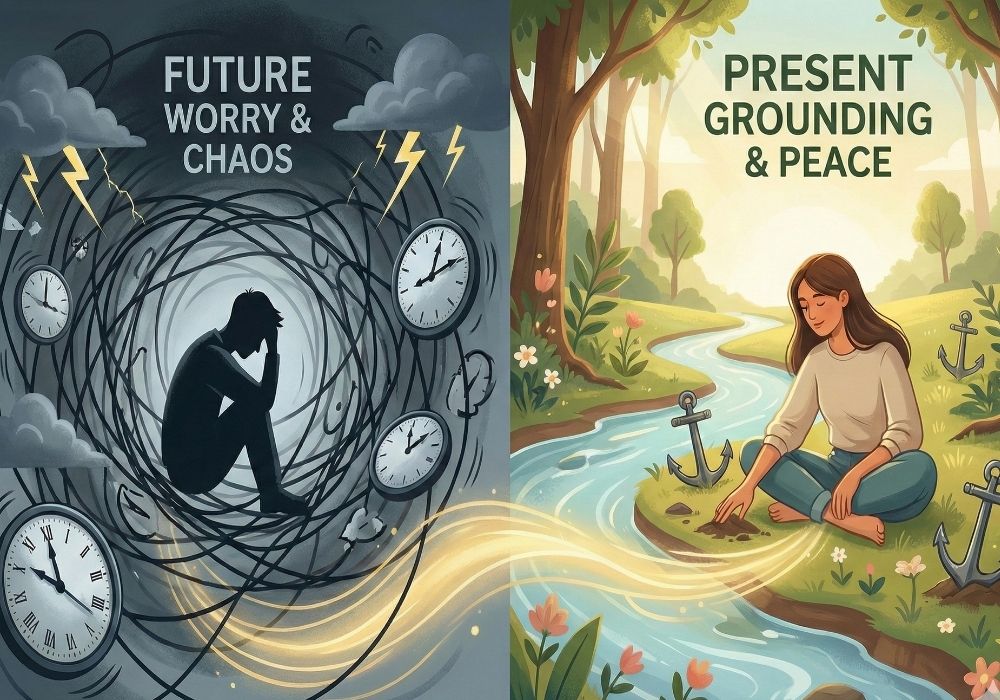
Anxiety isn’t just a “worry”, it’s a physical weight, a racing heart, and a constant projection into a future that hasn’t happened yet. At 101 Psychotherapy, we see people daily who are exhausted by this mental treadmill. One of the most effective ways we’ve found to pull the emergency brake on that cycle is through mindfulness therapy for anxiety. It isn’t about clearing your head of every thought, but rather changing how you relate to the chaos.
In this article
Why Our Brains Keep Overthinking
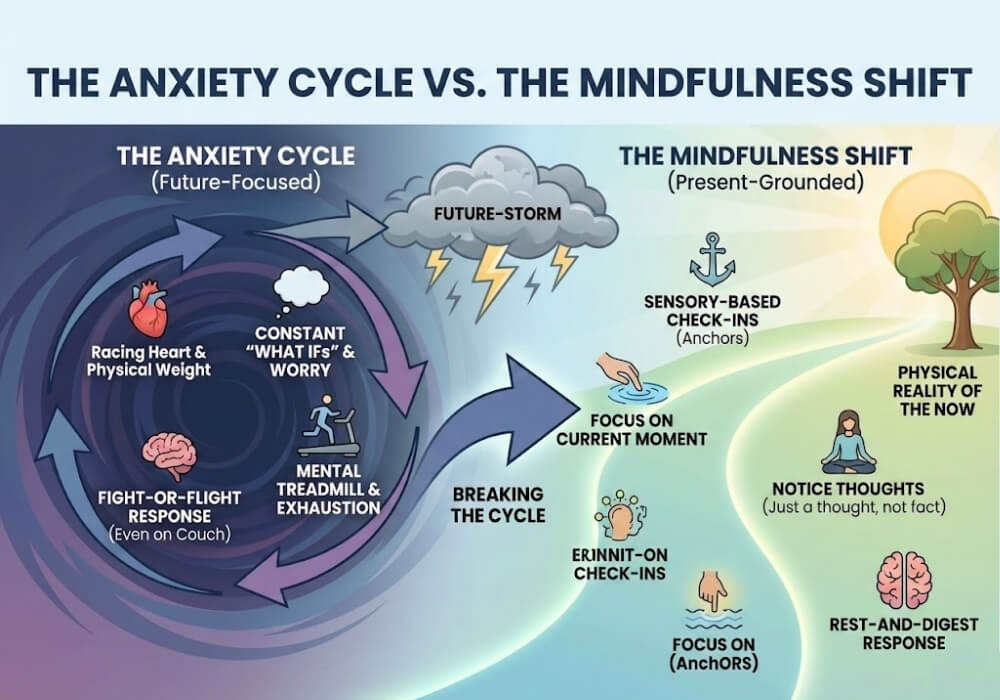
Anxiety thrives on the “what if.” It lives in the tomorrow, constantly scanning for threats and trying to solve problems that don’t exist yet. When you’re in that state, your nervous system is stuck in a fight-or-flight response, even if you’re just sitting on your couch. This is where the practice of being present becomes a literal biological necessity.
By focusing on the current moment, you deny anxiety the fuel it needs to grow. We use mindfulness therapy for anxiety to help people recognize that a thought is just a thought, it isn’t a command or a fact. When you stop fighting the feeling of being anxious and instead just notice it, the power dynamic shifts.
The Mechanics of Staying Present
Most people think mindfulness means sitting on a floor cushion for forty minutes in total silence. If you have high anxiety, that actually sounds like a nightmare because it gives your brain more room to scream. We prefer a more grounded, integrated approach.
Using mindfulness therapy for anxiety involves simple, sensory-based check-ins throughout the day. You might focus on the temperature of the water while you’re washing dishes or the specific feeling of your feet hitting the pavement while you walk to your car. These micro-moments of grounding act like anchors. They pull your consciousness out of the “future-storm” and back into the physical reality of the now.
Breaking the Cycle of Avoidance
A huge part of anxiety is the urge to run away from discomfort. We avoid certain places, conversations, or even our own feelings because they feel too intense. Ironically, this avoidance makes the anxiety grow larger over time.
We teach a different path, leaning in. Instead of running, we learn to sit with discomfort for just a few seconds longer than usual.
You might notice your chest feels tight and, instead of panicking about the tightness, you simply acknowledge it. “My chest feels tight right now.” That’s it. No judgment, no trying to fix it immediately. This process of “radical acceptance” makes anxiety stop feeling like a monster and starts being a temporary physical sensation that will pass.
Practical Steps for Daily Life
Integration is key. You don’t need a yoga mat or a special room to start seeing results. We often suggest people try a “S.T.O.P.” break:
- Stop what you’re doing for a second.
- Take a breath. Just one deep one.
- Observe what’s happening in your body and mind.
- Proceed with whatever you were doing, but with a bit more awareness.
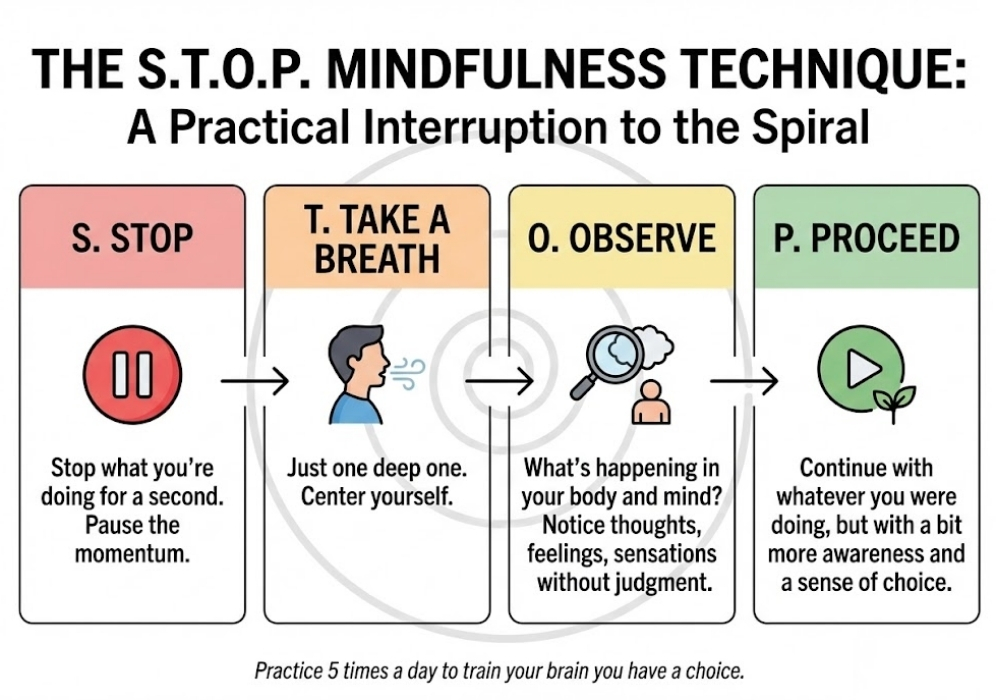
This small interruption breaks the momentum of a spiral. If you do this five times a day, you’re training your brain to realize it has a choice. If you want more exercises or a deeper dive into why your anxiety is there, we can help. Our team of psychotherapists all have the experience of treating anxiety through psychotherapy, so give us a call and we’ll help you gain control over your life again.
The Role of Professional Support
People often ask: Why does my mind wander when I try to meditate?
Because that is exactly what minds do. The mind wandering is not a failure, noticing that it has wandered and gently redirecting attention is the actual practice. Each redirect is a small mental rep. People who have meditated for years still experience distraction; the difference is that they catch it faster and without judgment.
Doing this alone is hard. Our brains are incredibly good at tricking us into old patterns of worry because those patterns feel familiar, and familiarity feels safe, even when it’s miserable. At 101 Psychotherapy, we act as a guide through this process.
Working with a therapist allows you to dig into why these triggers exist in the first place while simultaneously building the “mindfulness muscle.” We look at the roots, but we also give you the immediate tools to survive the day. Engaging in mindfulness therapy for anxiety provides a structured environment where you can experiment with these techniques without feeling like you’re doing it wrong. There is no “perfect” way to be mindful, there is only the practice of returning to the present moment, over and over again.
Redefining Your Relationship With Stress
Stress is a natural part of being alive, but it shouldn’t be the baseline of your existence. Chronic anxiety wears down the body and the spirit, leading to burnout and a feeling of being disconnected from your own life. When we implement mindfulness therapy for anxiety, the goal isn’t just to lower your stress levels, it’s to help you feel like “you” again.
Moving Forward
Did you know?
Studies using fMRI scans show that regular mindfulness practice produces measurable changes in the brain, specifically in the amygdala, which processes fear and the stress response. Long-term practitioners show reduced amygdala reactivity to emotional stimuli even when they are not actively meditating.

Taking the first step toward managing your mental health can feel daunting, but it’s also the most empowering thing you can do. If you’ve spent years feeling like your brain is your own worst enemy, it’s time to try a different tactic.
We focus on mindfulness therapy for anxiety because it works. It’s backed by science, it’s practical, and it puts the power back in your hands. You don’t have to live in a constant state of “what if.” You can learn to live in the present and find a sense of peace that doesn’t depend on everything in your life being perfect.
If you’re ready to stop the spiral and start feeling more grounded, we’re here to help you navigate that shift. It’s a journey, and usually a non-linear one, but it’s one worth taking. Your mind deserves to be a place where you feel at home, not a place you’re trying to escape.
Frequently asked questions
How long does it take for mindfulness to reduce anxiety?
Most people begin to notice a shift within two to four weeks of consistent practice, though even a single session can produce a measurable reduction in acute stress. The key is consistency, brief daily practice tends to produce stronger results than longer sessions done occasionally. Anxiety is a pattern that took years to build; rewiring it takes repetition.
Can mindfulness help with panic attacks?
Mindfulness can reduce the frequency and intensity of panic attacks over time, but it is not a technique to use during an active episode. During a panic attack, the goal is to ground yourself and let the physical response pass. Where mindfulness helps is in the quieter moments between attacks, building awareness of early warning signs before anxiety escalates.
What is the difference between mindfulness and meditation?
Meditation is a formal practice, you sit, set a timer, and deliberately focus your attention. Mindfulness is the broader quality of present-moment awareness that meditation trains. You can be mindful while washing dishes, walking to work, or having a conversation. The formal practice builds the capacity; everyday mindfulness is how you apply it.
Do I need a therapist to practice mindfulness?
Not necessarily. There are solid self-guided options including apps like Headspace or Insight Timer and structured programs like MBSR (Mindfulness-Based Stress Reduction). A therapist becomes especially useful when anxiety is severe, when you want to apply mindfulness within a broader treatment framework, or when starting on your own feels overwhelming.

Written by
Lev Dvorkin
Registered Psychotherapist
Depression Therapy, Stress Therapy, Anxiety Therapy, Collaborative Therapy Strategies
