

Overcoming the cultural stigma around mental health requires a blend of gentle education, setting firm boundaries, and understanding how your parents view the world. In many traditional families, emotional distress is viewed as a personal failure or a spiritual flaw. You can break this cycle by framing therapy as a standard medical tool, using physical symptom language your family already understands, and prioritizing your own healing journey above the expectations of others.
In this article
- Why Do Traditional Families Ignore Mental Health Struggles?
- What Are Common Myths About Therapy in Traditional Cultures?
- How Can You Talk to Immigrant Parents About Therapy?
- Is Intergenerational Trauma Real?
- How Can You Set Boundaries While Respecting Your Culture?
- What Are The First Steps To Healing For First Generation Adults?
- Frequently asked questions
Why Do Traditional Families Ignore Mental Health Struggles?
Growing up in a traditional household brings wonderful customs and a deep sense of community. It also frequently comes with strict expectations regarding emotional expression. Many older generations simply do not have the vocabulary to discuss depression or anxiety.
They often view psychological distress through a lens of survival. If they survived war, poverty, or immigration, they might perceive modern emotional issues as ungratefulness. This generational gap creates a massive disconnect when younger family members try to seek help. If you notice these tensions affecting the youth in your household, seeking out specialized counseling for adolescents dealing with family expectations can be a vital step in bridging that gap early on.
The Intense Pressure of Saving Face
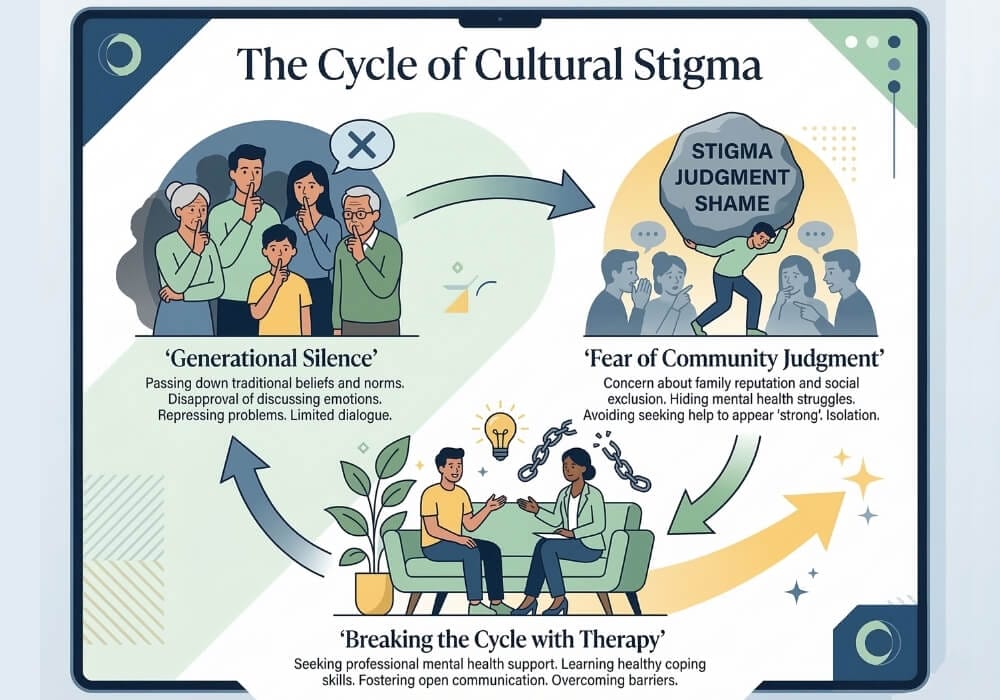
Many cultures prioritize the reputation of the collective family over the wellbeing of the individual. Asking for help outside the family unit is often seen as airing dirty laundry. This fear of community judgment fuels the cultural stigma around mental health.
Physical Symptoms Over Emotional Words
Traditional families often express emotional pain through somatic (physical) symptoms. Your parents might complain of chronic migraines, stomach pains, or extreme fatigue. They are actually experiencing clinical depression or anxiety, but their culture only permits them to seek help for physical ailments.

What Are Common Myths About Therapy in Traditional Cultures?
To dismantle the cultural stigma around mental health, we must first identify the specific lies being passed down. Generational misunderstandings thrive on misinformation.
Here is a breakdown of the most common myths found in traditional family dynamics and the actual reality.
| Cultural Myth | The Reality |
|---|---|
| Only “crazy” people need to see a therapist. | Therapy is routine maintenance for the brain, much like visiting a dentist for your teeth. |
| Mental illness is a sign of weak faith or poor spiritual practice. | Mental health conditions are biological and psychological realities requiring scientific intervention. |
| Talking to a stranger about family problems brings shame to the home. | Therapists are legally bound medical professionals offering unbiased, confidential support. |
How Can You Talk to Immigrant Parents About Therapy?
People often ask: Is therapy culturally appropriate for people from non-Western backgrounds?
Culturally competent therapy absolutely exists and is increasingly available. Therapists who specialize in working with clients from specific cultural backgrounds adjust their approach to account for collective family values, community expectations, and how shame and stigma show up within your culture. It is reasonable to ask a potential therapist about their cultural competency before committing.
Discussing mental health struggles with immigrant parents feels like speaking two different languages. You cannot always use Western clinical terms like “boundaries” or “trauma” right away. You must translate these concepts into a framework they respect.
Try these specific strategies when bridging the gap:
- Medicalize the issue: Compare therapy to physical therapy. Explain that you are seeing a doctor to manage extreme stress that is affecting your physical health or career.
- Focus on productivity: Many traditional cultures highly value academic or career success. Explain that therapy is a tool to help you focus better at work and achieve your goals.
- Avoid the blame game: Frame the conversation around your internal experiences rather than their parenting mistakes.
If you are struggling to navigate these intense conversations, learning how to establish rules is crucial. You might find it helpful to explore professional strategies for setting healthy boundaries in your relationships.
Is Intergenerational Trauma Real?
Yes. Trauma does not just disappear when a person immigrates to a new country or starts a new family. It lives in the nervous system and alters how parents raise their children.
Your parents might project their unhealed fears, scarcity mindsets, and hyper-vigilance onto you. This creates a cycle where their untreated survival mechanisms become your childhood wounds. Recognizing this pattern is the first step toward true healing.
How Can You Set Boundaries While Respecting Your Culture?
Did you know?
Research on mental health care outcomes shows that therapeutic alliance, the quality of the relationship between therapist and client, is the strongest predictor of treatment success, often more important than the specific type of therapy used. A good cultural fit with your therapist significantly strengthens that alliance.
You can love your culture without accepting the toxic elements of it. Honoring your parents does not require you to sacrifice your psychological safety.
You must realize that the cultural stigma around mental health is a societal flaw. It is not an absolute truth. According to the American Psychiatric Association, public stigma directly leads to discrimination and prevents millions from seeking the care they desperately need.
Here are clear steps to protect yourself:
- Stop seeking validation from family members who are not ready to understand.
- Find a culturally competent therapist who understands your specific background.
- Understand that seeking therapy secretly is completely valid if being open would cause emotional abuse.
What Are The First Steps To Healing For First Generation Adults?
Breaking cycles takes immense bravery. You are doing the heavy lifting for your entire family tree. By stepping into a therapist’s office, you are ending decades of silent suffering.
If you are raising children of your own, you have the power to change the narrative. You can teach them emotional intelligence early on and provide the preventative care that previous generations lacked.
The cultural stigma around mental health ends with you. At 101 Psychotherapy, we provide a safe, confidential space to unpack these complex family dynamics. You do not have to carry the weight of generational expectations alone.
Frequently asked questions
How do I talk to my parents about going to therapy without a difficult reaction?
Framing matters a lot. Many families from traditional cultures respond better when therapy is described in practical terms: problem-solving, stress management, or improving performance at work, rather than framing it as emotional or mental health treatment. You can also choose not to announce it at all. You are allowed to seek care privately.
Why do traditional cultures often view therapy as a sign of weakness?
In many cultures, emotional suffering is understood as either a spiritual matter or a private one to be resolved within the family. Seeking outside help can be interpreted as a betrayal, sharing private matters with a stranger, or as evidence that the family failed to raise a resilient person. These frameworks are understandable within their cultural context, even when they cause harm.
Can I go to therapy without telling my family?
Yes, absolutely. Therapy is confidential, and you have no obligation to disclose it to anyone. Many adults from traditional family backgrounds attend therapy privately for exactly this reason. If you are concerned about insurance claim visibility, private pay is an option many therapists offer.
How do I support a family member who refuses mental health help due to cultural beliefs?
You cannot force anyone into therapy. What you can do is stay connected, keep the door open without pressure, and remove one piece of stigma at a time through conversation. Sharing your own positive experiences with therapy, if you have them, tends to be more persuasive than abstract arguments about its value.
