

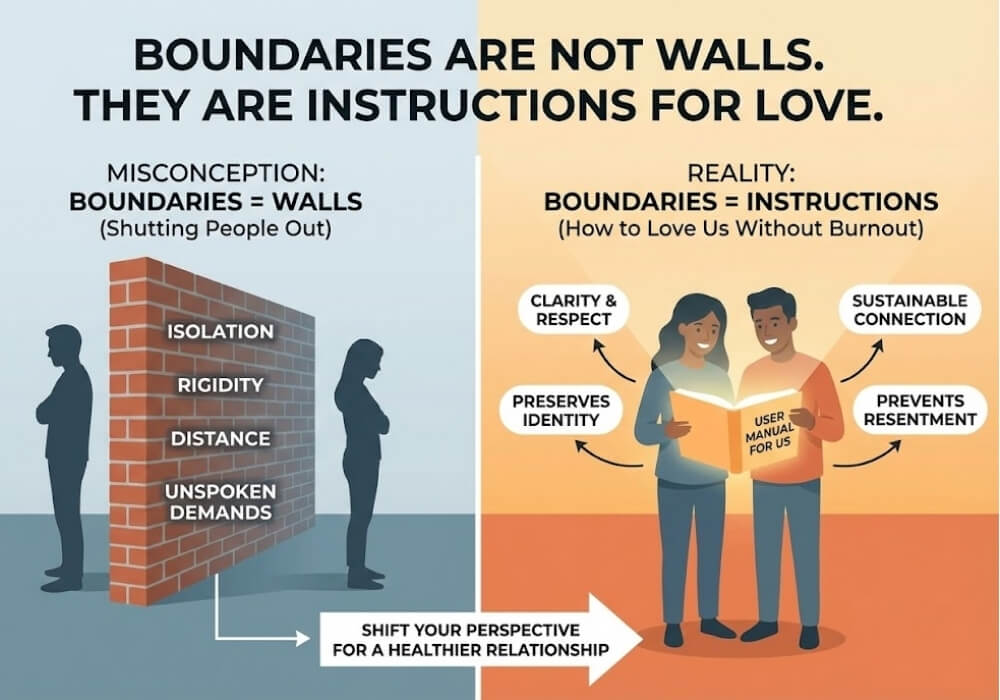
Boundaries get a bad reputation because people often confuse them with walls. When we talk about setting boundaries in a relationship, we aren’t talking about shutting people out or creating a list of demands. It is actually the opposite. We view boundaries as the instructions for how to love us without burning out. If you don’t tell someone where your edges are, they will inevitably step on them and you’ll end up resentful.
In this article
Setting Boundaries Preserves Your Identity
Most of us enter relationships and immediately start merging. It feels good at first to share everything, but eventually, you realize you’ve lost the parts of yourself that made you interesting in the first place. We see this often, one person stops seeing their friends or gives up a hobby because their partner doesn’t participate in it.
Healthy boundaries act as the line where you end and your partner begins. It’s okay to have a Sunday morning routine that doesn’t involve your spouse, and it’s actually healthy. When we stop setting boundaries in a relationship, we risk becoming a shadow of the other person. That lack of autonomy usually leads to a mid-relationship crisis where one person feels suffocated. By maintaining separate interests and time, you actually bring more value back to the dinner table because you have something new to talk about.
How Resentment Builds Up
If you find yourself snapping at your partner over something small like a dirty dish, the real issue is likely a boundary that was crossed weeks ago. Resentment grows in the gap between what you need and what you actually ask for. We tend to expect our partners to be mind readers. We think if they loved us, they would just know that we need an hour of silence after work.
The reality is that nobody knows your internal limits unless you vocalize them. Setting boundaries in a relationship means being brave enough to say “I can’t do that right now” or “I need a different approach to this conversation.” It feels uncomfortable in the moment, but that small bit of friction prevents a massive explosion later. You are essentially teaching your partner how to stay in your life for the long haul.
If you feel like you’re struggling to voice your real thoughts, you don’t have to do it alone. Let our psychotherapists help you strengthen your relationship through therapy, being able to properly communicate everything you want.
Moving past the fear of conflict
People often ask: Why do I feel so guilty after setting a boundary?
Guilt after setting a boundary usually means you grew up in an environment where your needs came second, and the guilt is that old message playing back. Feeling guilty does not mean you did something wrong, it means the limit was unfamiliar, not that it was unjust. The discomfort tends to reduce significantly with practice.
A common fear is that being firm about your needs will drive the other person away. If a boundary drives someone away, that person was likely benefiting from your lack of limits. Our team helps people realize that setting boundaries in a relationship is a filter. It filters out people who aren’t willing to respect you and strengthens the bond with those who are.
It helps to think about it as a roadmap. You wouldn’t try to drive across the country without a GPS or a map, yet we try to navigate the most complex emotional landscapes of our lives without any directions. When you say, “I need you to call if you’re going to be late,” you aren’t being controlling. You are providing the information your partner needs to keep the peace.
How to communicate your limits without sounding like a textbook
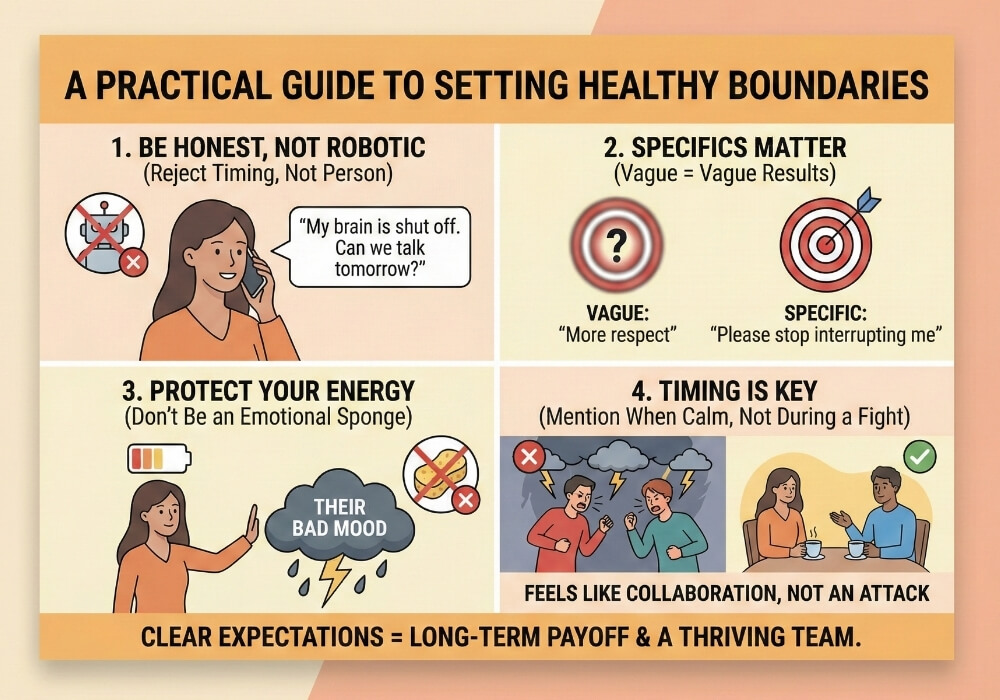
Forget the “I feel” statements for a second if they feel too robotic. Just be honest. If you’re exhausted and can’t handle a deep emotional talk at 11 PM, say that. “I want to hear this, but my brain is shut off for the night. Can we talk tomorrow morning?” This communicates that you aren’t rejecting the person or idea, you’re just rejecting the timing.
Specifics matter here. Vague boundaries lead to vague results. Instead of saying “I need more respect,” try “I need you to stop interrupting me when I’m explaining my day.” The more granular you get, the easier it is for your partner to actually succeed. We want our partners to win, and giving them clear rules of engagement is how we set them up for that success.
Reclaiming your emotional energy
Did you know?
Research in relationship psychology shows that couples who communicate explicit limits early in relationships report higher long-term satisfaction and lower rates of resentment, not because they argue more, but because unspoken expectations have less room to build.
We only have a finite amount of emotional “currency” to spend each day. If you spend it all catering to someone else’s whims or avoiding uncomfortable truths, you’ll have nothing left for your own growth.
You are not responsible for fixing your partner’s bad mood. You can be supportive, you can listen, and you can offer a hug, but you don’t have to carry the weight of their emotions on your back. Distinguishing between “being a supportive partner” and “being an emotional sponge” is a life-changing shift. It prevents the burnout that so many long-term couples face.
The long-term payoff of clear expectations
Think about the couples who have been together for forty years and still seem to genuinely like each other. They didn’t get there by accident. They got there by constantly negotiating their space. They understood that setting boundaries in a relationship isn’t a one-time event you do during a fight, it’s a living, breathing part of the daily routine.
As you grow and change, your boundaries will change too. What worked in your twenties might not work in your thirties when you have kids or a demanding career. Keeping the dialogue open about what you need. It stops the two of you from becoming roommates who just share a mortgage and turns you back into a team that actually functions.

Final Thoughts
We often see people wait until they are at a breaking point before they mention a boundary. By then, the tone is usually harsh and defensive. If you can start mentioning your needs when things are calm, it doesn’t feel like a localized attack. It feels like a collaboration.
Setting boundaries in a relationship isn’t a punishment. They are meant to protect the “us.” When both people know the rules of the game, they can play much harder and have a lot more fun. It takes away the guesswork and replaces it with a sense of security. You know where you stand, they know where they stand, and the relationship has the structure it needs to actually thrive rather than just survive.
Frequently asked questions
What is the difference between a boundary and an ultimatum?
A boundary is a clear statement of what you will and will not accept, rooted in your own needs, not a threat designed to control someone else’s behavior. An ultimatum says do this or I will do that. A boundary says I am not willing to be spoken to this way, and if it continues, I will need to step back. Boundaries protect you, ultimatums try to change the other person.
How do I set a boundary with someone who keeps crossing it?
A boundary that is not enforced teaches people that it has no real meaning. If someone repeatedly crosses a limit you have set, the question shifts from how do I explain it better to what am I prepared to do when it happens again. That might mean ending the conversation, creating distance, or reconsidering the relationship’s place in your life.
Is it selfish to have limits in a relationship?
No. Limits are how you stay present and available in a relationship without depleting yourself. People who give without any boundaries tend to build quiet resentment over time, which damages relationships far more than an honest conversation about needs would. Caring for yourself is what makes sustained care for others possible.
When should couples consider therapy to work on setting limits together?
Therapy is worth exploring when the same conversations keep cycling without resolution, when one or both partners feel consistently unheard, or when limit-setting has broken down into conflict rather than communication. A therapist provides structure and an outside perspective that most couples genuinely cannot create on their own.

Written by
Elena Nagovitsina
Registered Psychotherapist
Anxiety therapy, Cognitive Behavioural Therapy (CBT), Holistic Approach, Emotional Distress Therapy
