

Research shows that psychotherapy alone is highly effective at improving daily functioning by teaching long-term coping skills. However, for severe or persistent symptoms, clinical studies indicate that combining both therapy and medication produces the strongest overall outcomes.
You’re sitting in a doctor’s office, or perhaps staring at a telehealth screen, and you finally admit you’re struggling. The immediate response is often a prescription pad. For many, that small piece of paper brings a massive wave of relief. For others, it brings a flood of anxiety.
You might find yourself wondering: Can I just talk this out? It is incredibly common that people who start therapy avoid medication entirely. If I work hard enough, can I skip the prescriptions altogether?
It’s one of the most common questions we hear at 101 Psychotherapy. The short answer? Therapy and medication are entirely different tools in your mental health toolkit. One doesn’t automatically replace the other. But the long answer is where the science gets incredibly fascinating, and where your personal power in your mental health journey truly lies.
Let’s break down what actually happens when you choose the therapy route, when medication becomes necessary, and how to make the best choice for your brain.

In this article
Rewiring the Brain: How Psychotherapy Works Alone
There is a persistent myth that talk therapy is just “paying someone to listen to you complain.” If you’re working with a skilled psychotherapist, nothing could be further from the truth. Evidence-based therapies actually change the neural pathways in your brain, much like learning a complex new language or mastering an instrument.
Often, those who commit to therapy avoid medication by actively working on:
- Cognitive Restructuring: Identifying the invisible scripts and cognitive distortions that fuel your anxiety or depressive episodes.
- Distress Tolerance: Building the emotional muscle to sit with uncomfortable feelings without spiraling.
- Behavioral Activation: Systematically re-engaging with your life to jumpstart your brain’s natural reward systems.
Does therapy work as well as medication?
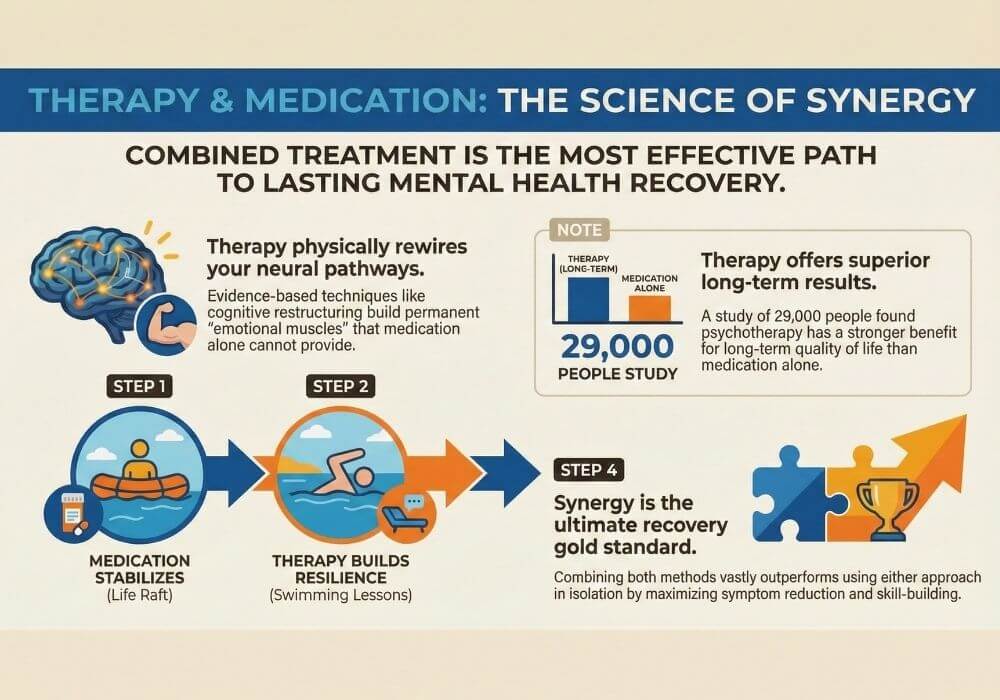
Yes, and the numbers back it up. A massive, landmark meta-analysis on the efficacy of psychotherapy, pharmacotherapy and their combination in depression (Kamenov et al., 2016) reviewed data from over 29,000 participants. The researchers found that psychotherapy alone independently led to small-to-moderate improvements in daily functioning and quality of life.
In fact, after adjusting for publication bias, the study revealed something incredible, psychotherapy showed a slightly stronger benefit for long-term quality of life than medication alone. Why? Because while medication chemically alters your baseline, therapy gives you the permanent coping skills to handle the inevitable curveballs life throws your way.
If you’re looking for treatment for your depression, or situational stress, you’ll find that many who lean into therapy avoid medication and use psychotherapy as an effective standalone option.

The Ceiling Effect: When Therapy Needs Backup
People often ask: Does therapy work as well as antidepressants for anxiety?
For anxiety disorders, research suggests that CBT is often equally effective as medication in the short term and more durable over the long term, with lower relapse rates once therapy ends compared to when medication is stopped. The best outcomes for moderate to severe anxiety often come from combining both approaches, at least initially.
We love therapy. We champion it. But we also believe in absolute transparency. While it is a fact that some who use therapy avoid medication successfully, there is a ceiling to what willpower and talk therapy can achieve if your brain chemistry is actively working against you.
Imagine trying to build a house in the middle of a Category 5 hurricane. You might have the best blueprints (coping mechanisms) and the best tools (therapeutic strategies), but the wind keeps knocking you over before you can lay a single brick.
That hurricane is severe mental illness. When symptoms are incredibly intense, when you cannot get out of bed, when panic attacks are constant, or when executive dysfunction is entirely paralyzing, relying solely on psychotherapy without considering psychotherapy, pharmacotherapy and their combination in depression can feel like an impossible uphill battle.
The Ultimate Synergy: Why Combined Treatment Wins
The same 2016 Kamenov study that championed psychotherapy had a crucial secondary finding, the combination of psychotherapy and medication produced the strongest overall outcomes. It vastly outperformed either approach used in isolation. Think of medication as the life raft that keeps your head above water, and therapy as the swimming lessons that teach you how to reach the shore.
Here is how the combined approach typically plays out in a clinical setting:
- Symptom Reduction: Medication kicks in (often within a few weeks), turning down the volume on the crippling dread, intense anxiety, or heavy fatigue.
- Increased Capacity: Because you aren’t fighting a chemical hurricane anymore, you suddenly have the mental bandwidth to actually absorb what your therapist is teaching you.
- Long-Term Mastery: You use this stabilized period to build emotional resilience, process trauma, and establish healthy boundaries.
- Potential Tapering: Down the line, under the supervision of your doctor, many people find that the skills they learned in therapy allow them to safely taper off their medication.
Making the Right Call for Your Mental Health
Did you know?
A landmark meta-analysis published in World Psychiatry analyzed over 500 studies and concluded that therapy and medication show comparable efficacy for depression and anxiety across most presentations. For mild to moderate severity, therapy alone is typically sufficient.
At 101 Psychotherapy, we don’t believe in a one-size-fits-all approach. Your nervous system is uniquely yours.
We understand why many people seeking therapy avoid medication initially. If your goal is to handle your mental health naturally, we will work relentlessly with you to build a robust toolkit of behavioral, cognitive, and emotional strategies. We can explore everything from deep trauma processing to practical, everyday mindfulness techniques.
However, if we notice that you’re hitting a wall, and that your symptoms are preventing you from living the life you deserve, we will have an honest, stigma-free conversation about integrating medical support. Our clinic collaborates seamlessly with medical professionals to ensure your care is holistic and comprehensive.
You don’t have to choose a side in a nonexistent war between medication and therapy. You just have to choose what works for you.
Frequently asked questions
Can therapy replace antidepressants for mild to moderate depression?
For mild to moderate depression, research consistently shows that psychotherapy, especially CBT, is as effective as medication, and that the gains tend to last longer after treatment ends. Medication addresses neurochemistry, therapy builds skills and changes patterns. For many people, therapy alone is a complete and durable treatment.
What happens if I stop taking medication and try therapy instead?
This is a conversation that must happen with your prescribing physician, not a self-directed decision. Abruptly stopping many psychiatric medications can cause discontinuation symptoms that are genuinely unpleasant or, in some cases, dangerous. The typical approach is a gradual taper under medical supervision, ideally with therapy already in progress during the transition.
Which types of therapy work best without medication?
Cognitive Behavioural Therapy (CBT) has the strongest evidence base for anxiety and depression and is often the first recommendation when trying therapy as a standalone treatment. Dialectical Behaviour Therapy (DBT) is particularly effective for emotional dysregulation. ACT and mindfulness-based approaches are also well-supported for mild to moderate presentations.
How do I bring up trying therapy before medication with my doctor?
Be direct. You can say: I want to try a structured therapy approach before starting medication. A good physician will take that preference seriously and help you monitor symptoms closely. Come prepared with a sense of how long you are willing to give therapy before reconsidering, this makes the conversation easier for both of you.

Written by
Lev Dvorkin
Registered Psychotherapist
Depression Therapy, Stress Therapy, Anxiety Therapy, Collaborative Therapy Strategies
