

Most people view their morning drive or train ride as a neutral gap between home and work. We see it differently because we talk to people every day who are losing their mental edge before they even clock in. The physical act of moving from one place to another isn’t the problem, it’s the dreaded traffic and cognitive load of being stuck in a state of high-alert passivity. You are hyper-focused on traffic or delays, yet you have zero control over the outcome. This is one of the biggest reasons why commuting burnout is caused by stress.
In this article
Identifying The Burnout From Commuting
Burnout doesn’t usually happen because of the job itself, it happens because the transition periods are failing to provide a buffer. When we look at commuting burnout caused by stress, we see it manifesting as a specific type of irritability that shows up before you’ve even had your first meeting. You might notice that your patience is nonexistent by 9 AM, or you feel a sense of dread as soon as you grab your keys. This isn’t just “disliking traffic.” It is a cumulative nervous system response to being trapped in a high-stakes environment where you can’t move freely.
The brain wasn’t built to handle the sensory overload of a modern commute for two hours every day. Between the flashing brake lights, the noise of a crowded subway, and the constant scanning for danger, your amygdala stays active for far too long. Over months and years, this constant “on” state wears down your ability to regulate emotions. You end up arriving at work with a depleted tank, forcing you to trudge along for the rest of the day.
Why the “Third Space” is disappearing
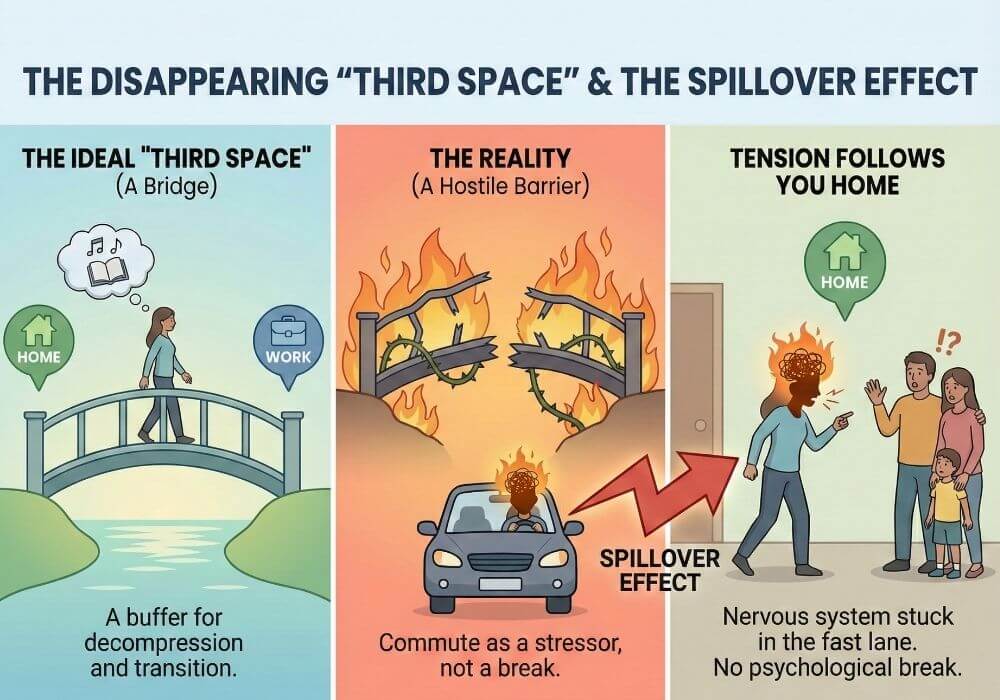
In sociology, there is a concept of the third space, a place that isn’t work and isn’t home. Historically, the commute served as a primitive version of this, but the modern version has become too hostile to function that way. Instead of a bridge, it’s a barrier. We find that many people are suffering from commuting burnout caused by stress because they’ve lost the ability to decompress. If your drive home is spent ruminating on a work conflict while fighting for a lane change, your brain never gets the signal that the workday is actually over.
This creates a “spillover effect.” The tension from the highway follows you into the kitchen. You find yourself snapping at your partner or kids not because they did something wrong, but because your nervous system is still stuck in the fast lane. True recovery requires a clear psychological break, and for many commuters, that break simply doesn’t exist anymore. You are essentially working a 10-hour day but only getting paid for eight, and your brain knows it.
If you’re fed up with this extended tension and feel like there’s no way out, we can give you that escape. Our team has helped plenty of clients manage their stress through therapy, and get over the dread of commuting.
The physiological cost of the daily grind
People often ask: Is commuting stress really that serious if I am otherwise healthy?
Research suggests that commuting stress is one of the daily stressors most resistant to habituation, meaning most people do not adapt to it the way they might adapt to other stressors. Extended commutes are consistently linked to lower life satisfaction, reduced sleep quality, and higher rates of anxiety and depression, even among otherwise healthy people.
Sitting in a car or standing on a train for extended periods triggers a low-level fight-or-flight response. Your heart rate is slightly elevated, your muscles are tense, and your cortisol levels start to spike. When we discuss commuting burnout caused by stress, we have to address the fact that your body is physically reacting to the commute as if it were a threat. Doing this twice a day, five days a week, leads to chronic inflammation and sleep disturbances.
We see a lot of “revenge bedtime procrastination” in heavy commuters. Since you feel like your entire day was stolen by work and travel, you stay up late just to reclaim some sense of personal time. This creates a vicious cycle, you’re exhausted because you stayed up late, which makes the next morning’s commute feel even more grating, further increasing your cortisol. Breaking this loop requires more than just a better playlist, it requires a complete reevaluation of how you value your time.
Redefining the transit period
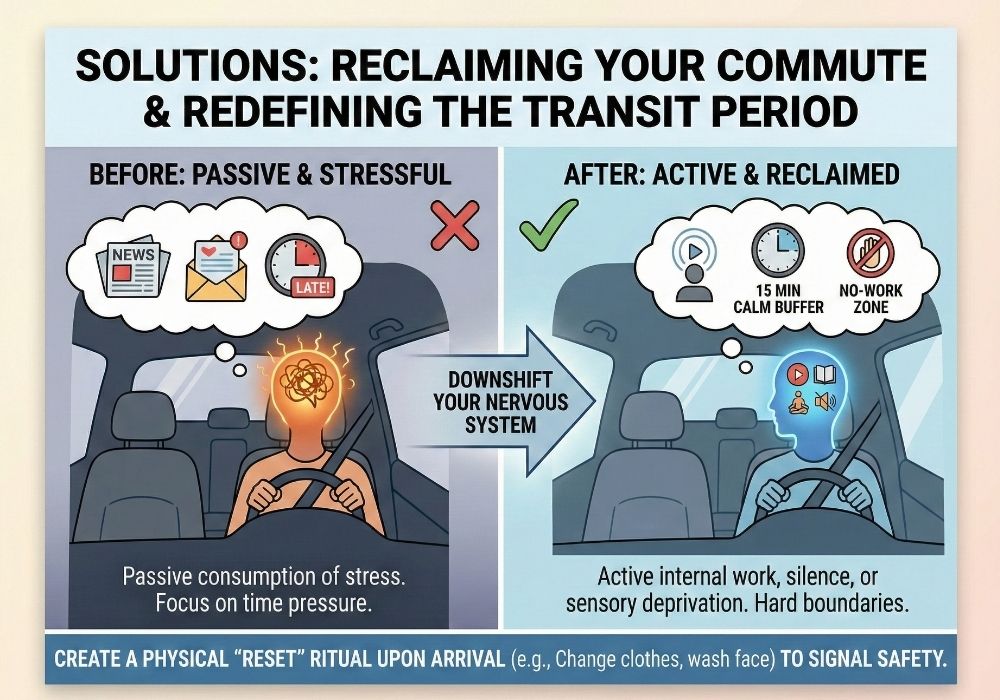
If you can’t change the distance of your drive, you have to change the psychological environment of the vehicle. Passive consumption of the news or stressful talk radio usually makes things worse. We often suggest people lean into “active” internal work or total silence. Silence is underrated. In a world of constant pings and notifications, thirty minutes of quiet in a car can actually act as a form of sensory deprivation therapy.
When you’re dealing with commuting burnout caused by stress, the goal is to downshift your nervous system. This might mean leaving ten minutes earlier just to remove the “time pressure” element. The stress isn’t just the traffic, it’s the fear of being late. By removing the consequence of a delay, you take the teeth out of the stressor. It’s a small shift, but it changes the commute from a race into a simple transition.
The impact on long-term career satisfaction
Did you know?
A UK government study tracking thousands of workers found that adding 20 minutes to a commute had the same negative effect on job satisfaction as a 19% pay cut. The psychological cost of transit time is real and measurable, not just a personal sensitivity.
You might love your job, but if the path to get there is traumatic, you won’t stay. The commute is a silent killer of career longevity. It erodes your ambition because you start to associate your professional identity with the misery of the journey.
If you are a manager, recognizing this in your team is vital. A person who lives five minutes away is fundamentally experiencing a different job than the person who lives ninety minutes away. Flex hours or hybrid options aren’t just perks, they are mental health interventions. Reducing the frequency of the “threat” allows the nervous system to reset, making the days you are in the office much more productive and less resentful.
Finding a way back to yourself
Recovery from this specific type of exhaustion starts with acknowledging that it is valid. You aren’t “weak” because the drive wears you out. You are reacting to a demanding, unnatural environment. Address this issue by creating hard boundaries around your transit time. No work calls while driving. No checking emails on the train. Make that space a “no-work zone” so your brain can at least attempt to find a baseline.
We also encourage people to do a physical “reset” the moment they get home. Change your clothes immediately. Wash your face. Do something that signals to your body that the commute is over and you are safe now. These rituals help divide your life into manageable segments rather than one long, blurry grey line of obligation.
Reclaiming Your Commute
Most people start their commute in a rush, which sets a chaotic tone for the day. If you can reclaim even fifteen minutes of calm before you leave the house, you build a small reserve of patience. That reserve is what keeps you from hitting a breaking point when there is an accident on the bridge.
At 101 Psychotherapy, we believe that your mental health is tied to the transitions in your life. If the “middle” of your day is filled with commuting burnout caused by stress, the beginning and the end will eventually suffer. It’s worth looking at your route, your timing, and your habits to see where you can claw back some peace. You deserve to arrive at your destination feeling like yourself, not a frayed version of the person who left the house.
Frequently asked questions
How many hours of commuting per week is considered harmful?
Research suggests that commutes longer than about 45 minutes each way are associated with higher rates of stress, lower relationship satisfaction, and reduced psychological wellbeing. The effects compound over years. Most people adapt to the schedule without realizing how much it is quietly costing them until the exhaustion becomes unmistakable.
What makes commuting so psychologically draining compared to other stressors?
The core issue is sustained vigilance combined with complete lack of control. You are in a heightened state of attention, monitoring traffic or delays, but you cannot influence the outcome. This state of high-alert passivity keeps your nervous system activated for long stretches with no productive release, which mimics the neurological profile of chronic low-grade stress.
Can a long commute cause anxiety?
A long commute can trigger and worsen anxiety, especially in people who already struggle with uncertainty or lack of control. Repeated unpredictability, not knowing if you will be late, whether the train will come, reinforces anxious thinking patterns. It can also disrupt sleep when commute preparation eats into morning routines or keeps people mentally engaged into the evening.
How do I know if my commute is affecting my mental health?
Some clear signs: you feel tense or irritable before you even arrive at work, you dread Sunday evenings because Monday’s commute is looming, or you arrive home too depleted to be present with family or to take care of yourself. If your commute is the first thing you name when asked what is wearing you out, that matters.

Written by
Lev Dvorkin
Registered Psychotherapist
Depression Therapy, Stress Therapy, Anxiety Therapy, Collaborative Therapy Strategies
