

Most people wait until they can’t get out of bed to admit they are struggling, but burnout usually starts long before that total collapse. At 101 Psychotherapy, we see people who are high-functioning but hollowed out. They are still hitting their deadlines and showing up to meetings, yet their internal world feels like a desert. Burnout isn’t a badge of honor or a sign that you’ve worked hard enough to “earn” a break. It is a physiological state where your brain has decided that the environment is no longer safe or sustainable. Getting early help with work burnout is the only way to pivot before your body makes the choice for you.
In this article
Burnout Causing Emotional Numbness
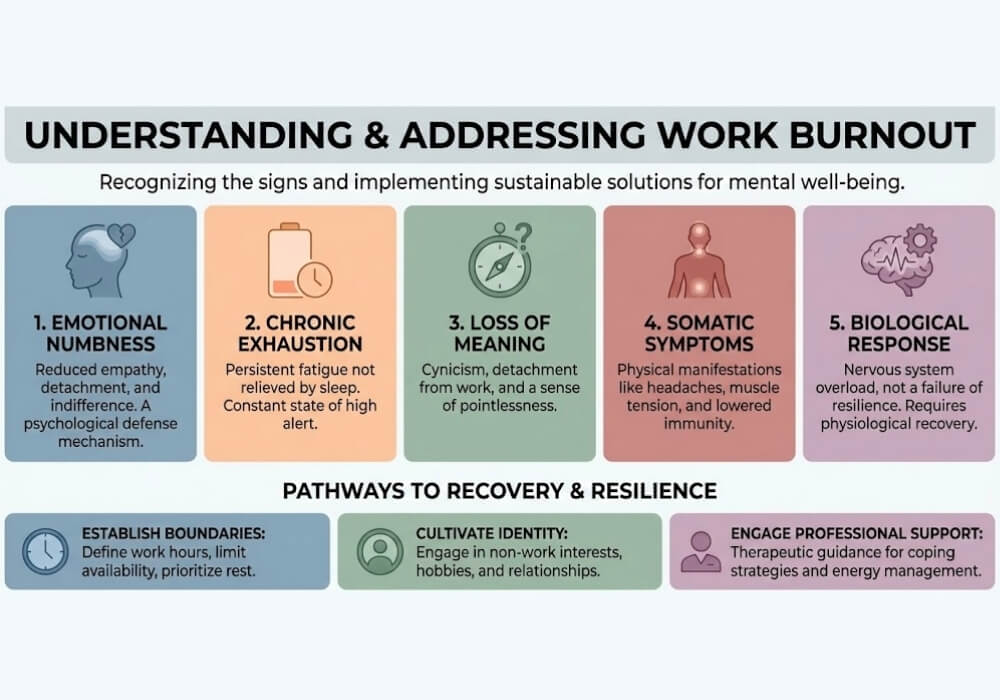
One of the first things to go when you are overloaded is your capacity for empathy and patience. You might find that you are snapping at a coworker for a minor typo or feeling a strange sense of indifference when a project succeeds. This emotional numbness is a defense mechanism. Your brain is trying to conserve energy by dulling your responses to external stimuli. If you don’t feel anything, the theory goes, you can’t be hurt or stressed further.
When you start searching for help with work burnout, this is often the symptom that drives the search. It is jarring to realize you no longer care about things that used to bring you pride. This irritability isn’t a personality flaw, it is a sign that your nervous system is stuck in a low-level fight-or-flight mode. You aren’t “becoming a mean person,” you are simply a person whose capacity to regulate emotions has been compromised by a relentless schedule.
Constant mental exhaustion that sleep won’t fix
There is a fundamental difference between being sleepy and being exhausted. Sleepy is fixed by a long weekend or a few early nights. Burnout exhaustion is much deeper. It’s that heavy, foggy feeling where simple decisions, like what to eat for dinner, feel as taxing as a board presentation. You wake up after eight hours of sleep and still feel like you’ve been hit by a truck. This happens because your brain is staying in a high-cortisol state even while you are “resting.”
Seeking help with work burnout at this stage usually involves learning how to actually downregulate your nervous system. If your mind is still racing about tomorrow’s to-do list while you’re in bed, you aren’t actually resting. You’re just lying down while your brain runs a marathon. This cognitive fog makes you less efficient, which usually leads to working longer hours to compensate, which makes the exhaustion worse.
If you need help finding a way to break that cycle, our experienced team of psychotherapists know exactly what to do. We can help you manage your stress through therapy, so you can actually start relaxing once you’re out of the office.

No motivation and “What’s The Point”
People often ask: Can you be burned out but still high-functioning?
Yes, and this is one of the more dangerous forms of burnout. High-functioning burnout looks like someone who is still hitting their targets and showing up, but who feels completely hollowed out internally. The outward performance masks the depletion, which means the person often does not seek help until the system breaks down completely.
When burnout takes hold, your internal reward system effectively shuts down. Tasks that once felt like a healthy challenge now feel like a pointless weight. You start to look at your career and wonder why you ever cared in the first place. This loss of meaning is particularly painful for people who derive a lot of their identity from their work.
We find that you need to address this loss of identity. It’s hard to find motivation when your brain has associated your job with pain rather than progress. You might start procrastinating on simple emails, not because you are lazy, but because your mind is trying to protect you from more work. It’s a subconscious strike. If you can’t find the spark anymore, it’s not because you’ve lost your talent, it’s because your system is too depleted to ignite.
Physical symptoms and the body’s warning lights
Burnout isn’t just in your head. It shows up in your gut, your back, and your immune system. If you are catching every cold that goes around the office or dealing with mystery headaches, your body is trying to communicate what your mind is ignoring. We see a lot of people who come in for anxiety only to realize their physical ailments are directly tied to their workplace stress.
Looking for help with work burnout should involve a look at your physical health too. Are you clenching your jaw at your desk? Is your posture guarded like you’re waiting for a blow? These are physical manifestations of a mind that doesn’t feel safe. Your body is screaming for a change of pace. Ignoring these signs leads to long-term health issues that are much harder to fix than a temporary career slump.
Why your nervous system is calling the shots
Did you know?
A 2021 survey of Canadian workers found that 35% reported experiencing burnout symptoms. Mental health professionals describe burnout as existing on a spectrum, most people will experience a recognizable phase of it at some point in their working lives.
We need to be clear, burnout is a nervous-system response to prolonged stress, not a personal failure. Our society treats it like a lack of “grit,” but your biology doesn’t care about grit. If you put a car in redline for five hours, the engine will melt. Your brain works the same way. When you operate in a state of high pressure without adequate recovery, your parasympathetic nervous system, the part that handles “rest and digest”, wastes away.
Finding help involves retraining your body to feel safe again. It means setting boundaries that feel uncomfortable at first, like closing your laptop at 5 PM regardless of what is left in the inbox. It’s about convincing your brain that the world won’t end if you are unavailable. This is deep work because it often touches on our core fears of inadequacy or being replaced. But the alternative is a total system failure that takes months or years to recover from.

Reclaiming your life outside of the office
If the only thing you do is work and recover from work, you aren’t living, you’re just maintaining a machine. You need a life that is big enough to make your job feel small. When work is the only thing on your plate, every professional setback feels like a life-threatening event. When you have a rich life outside of your career, a bad day at the office is just a bad day at the office.
Professional help with work burnout often focuses on diversifying your “identity portfolio.” We want you to have hobbies, friendships, and interests that have absolutely nothing to do with your productivity. This creates a buffer. It gives your brain a place to go where it isn’t being judged on its output. The more you can detach your self-worth from your salary or your title, the more resilient you become to the inevitable stresses of a career.
Moving toward a sustainable pace
The goal isn’t to get back to the same level of overworking that burned you out in the first place. That’s a mistake people make all the time. They take a two-week vacation, feel slightly better, and then jump right back into the fire. True help with work burnout is about building a new way of working. It’s about pacing.
Sustainable careers are marathons, not sprints. You have to learn how to manage your energy, not just your time. This might mean saying no to “opportunities” that are actually just more work in disguise. It means being honest with your boss about what is realistic. Most importantly, it means being honest with yourself about what you actually need to stay healthy. You are the only person who can truly advocate for your well-being.
Frequently asked questions
What is the difference between work burnout and clinical depression?
Burnout and depression share overlapping symptoms, exhaustion, low motivation, difficulty concentrating, but they differ in origin and scope. Burnout is primarily tied to a specific context, usually work, and tends to improve with rest and distance from the stressor. Depression is broader, persists across all areas of life, and does not necessarily improve with time off alone.
Can burnout cause physical health problems?
Yes. Chronic burnout activates the body’s stress response in a sustained way, contributing to sleep disruption, weakened immune function, digestive issues, and elevated cardiovascular risk. Many people first notice burnout in their bodies, recurring headaches, getting sick more often, or persistent tension in the chest or shoulders.
How long does it take to recover from work burnout?
Mild burnout caught early can improve within weeks with reduced demands and deliberate rest. Deeper burnout that has been building for months or years often takes three to six months of intentional recovery, including both external changes like reduced workload and internal work, typically with therapeutic support.
Is changing jobs the only way to recover from burnout?
No. Many people recover through a combination of boundary-setting, better self-advocacy, reduced responsibilities, and therapeutic support, without changing employers. What matters most is identifying what is actually driving the burnout, which is not always the job itself.

Written by
Alex Kazmin
Registered Psychotherapist
CBT approach, DBT techniques, Gestalt therapy, Existential Therapy, and a holistic attitude
