

In this article
Imposter syndrome does a particularly good job of hiding in plain sight. The people it targets most, professionals who are consistently performing well, tend to have the least reason to trust the feeling and the most reason to push through it without naming it. You know you are competent. Your record shows it. And yet there is a persistent background anxiety that you are operating on borrowed time and that someone is eventually going to notice. That is imposter syndrome, and it is more common in high-performing environments than anywhere else.
What imposter syndrome actually is
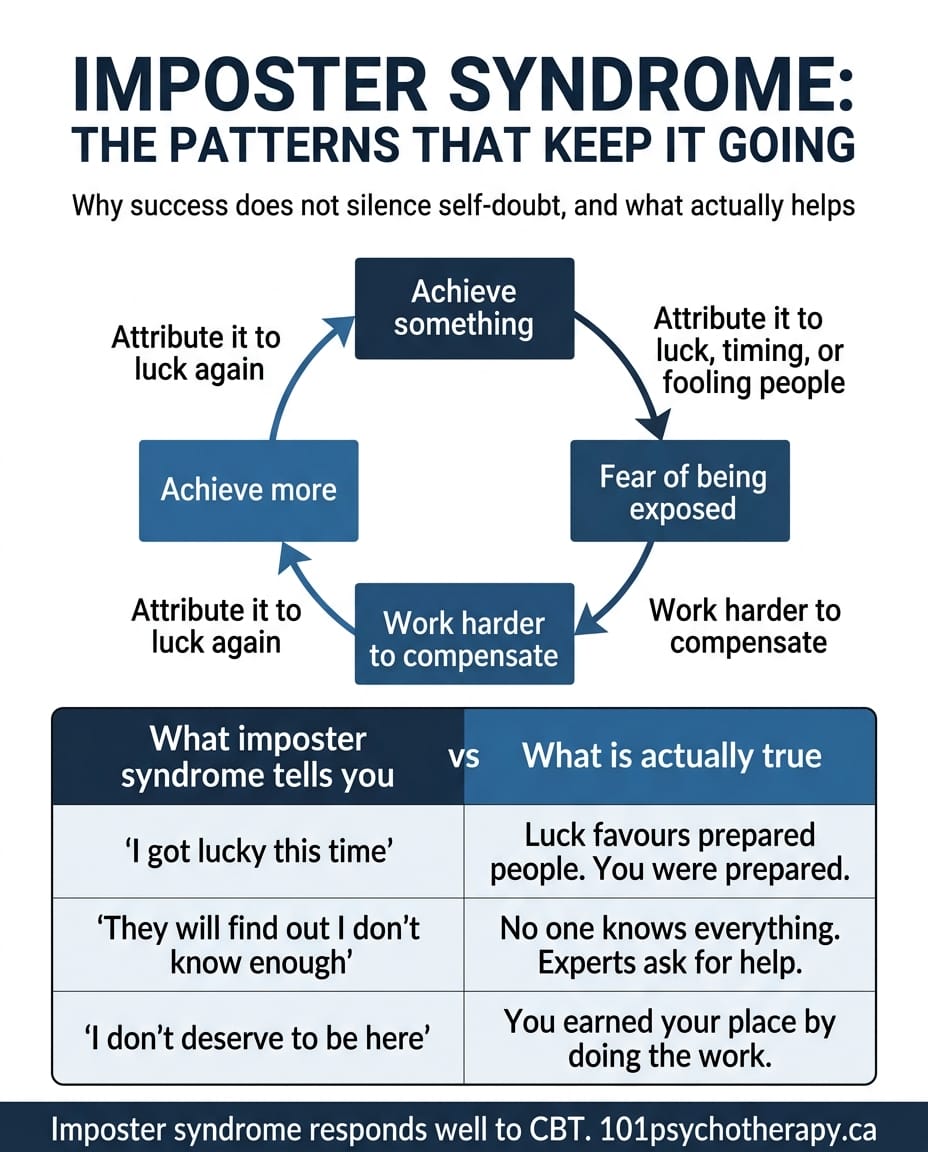
The term was coined in 1978 by psychologists Pauline Clance and Suzanne Imes, who noticed a consistent pattern among high-achieving women: a belief, despite external evidence, that their success was not deserved and would eventually be exposed as a fraud. The pattern has since been documented across genders, fields, and seniority levels. Studies suggest 70 percent of people experience it at some point, with higher rates among those in new roles, highly competitive environments, or situations where they feel like an outsider. The core mechanism: success gets attributed to luck, timing, or fooling people, while failure gets attributed to genuine incompetence. This means no amount of external evidence of competence actually challenges the core belief.

People often ask: Is imposter syndrome a real psychological condition?
Imposter syndrome is not a clinical diagnosis, but it’s a well-researched psychological pattern. First described by psychologists Pauline Clance and Suzanne Imes in 1978, it involves persistent self-doubt and fear of being ‘found out’ despite clear evidence of competence. It responds well to CBT-based approaches.
Why it disproportionately affects high achievers
High achievers face a specific compounding problem: their standards rise with their performance. Every time they achieve something new, the bar moves. There is always more to know, more to be responsible for, a higher-level peer to compare against. Add to this that high-performing environments often value confidence and certainty, making it feel unsafe to acknowledge doubt. The result is a gap between the composed, competent exterior and the anxious interior, and no obvious place to put the gap.
Did you know?
The term ‘imposter syndrome’ was coined in 1978 after Clance and Imes studied high-achieving women in academic settings. More recent research shows it affects people across genders, industries, and seniority levels at roughly equal rates.
The cycle that keeps imposter syndrome running
Imposter syndrome persists because the coping strategies feel helpful but actually maintain the pattern: Overworking: Working much harder than the situation requires to make sure nothing slips through. This does produce results, which reinforces the belief that you were nearly exposed, and that only the extra effort saved you. Avoiding challenges: Turning down opportunities, not applying for roles, staying quiet in meetings to avoid scrutiny. Avoidance reduces anxiety temporarily but prevents the corrective experience of handling a challenge successfully. Discounting feedback: When someone praises your work, the first instinct is to find reasons they are wrong. This keeps positive evidence from actually updating the core belief.

What therapy does for this pattern
CBT addresses imposter syndrome by targeting the specific thoughts that constitute the fraud belief, not by trying to make you feel more confident. The process involves:
- Identifying the exact content of the imposter thoughts
- Examining the evidence for and against each belief
- Testing whether the fear holds up under scrutiny (it typically does not)
- Gradually building tolerance for the discomfort of being seen and still valued
This is not about replacing negative thoughts with positive ones. It is about developing a more accurate, evidence-based relationship with your own performance, one where success does not require an explanation that diminishes you.
Our therapists at 101 Psychotherapy work with professionals dealing with imposter syndrome, work anxiety, and burnout across Vaughan, Richmond Hill, Aurora, and Brampton. Book a free consultation.
Frequently asked questions
Is imposter syndrome a mental health condition?
No. Imposter syndrome is a psychological pattern, not a formal diagnosis. The term was coined in 1978 by psychologists Pauline Clance and Suzanne Imes. It describes a specific set of thoughts and behaviours, not a disorder. That said, when it is severe enough to cause significant anxiety, avoidance, or burnout, it warrants the same attention as any other mental health concern.
Why do high achievers experience more imposter syndrome?
A few reasons. High achievers set higher standards for themselves and others, so the gap between what they think they should know and what they actually know feels larger. They are also more likely to be in new, challenging environments where genuine uncertainty exists, and they may be acutely aware of how much more there is to learn. Success also raises the perceived stakes of being exposed.
Does imposter syndrome ever go away?
For many people, it reduces significantly but does not disappear entirely. Therapy helps by targeting the thinking patterns and avoidance behaviours that maintain it, not by eliminating all self-doubt, which would be neither realistic nor desirable. The goal is to get to a place where the self-doubt is present but does not run your decisions.
Can imposter syndrome affect relationships, not just work?
Yes. Some people feel like frauds in their relationships, parenting, or friendships, believing they are not as good a partner or parent as others perceive. The same core mechanism applies: success or positive regard is explained away while perceived failures are treated as confirmation of genuine inadequacy.
What is the CBT approach to imposter syndrome?
CBT addresses imposter syndrome by identifying the specific thoughts that constitute the fraud belief, examining the evidence for and against them, and testing them through behavioural experiments. This is not about replacing negative thoughts with positive ones but about developing a more accurate, evidence-based relationship with your own performance and competence.
Download the free guide
Save this as a free PDF guide.
