
In this article
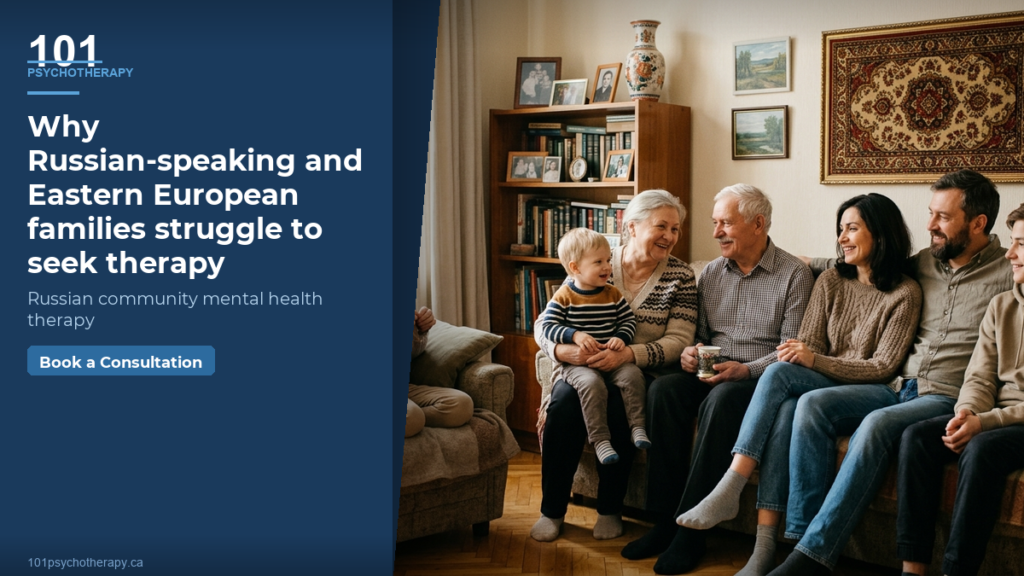
If you grew up in a Russian-speaking or Eastern European family, you likely know the unspoken rules around mental health. You do not talk about it outside the family. You do not show weakness. You manage what you can, and what you cannot manage, you keep quiet about. This is not a character flaw or a cultural defect. It has roots that go deep, into history, into survival, and into a specific relationship with authority and disclosure that does not simply disappear in a new country. Understanding where the resistance comes from is more useful than judging it.
The historical roots of mental health stigma in post-Soviet culture
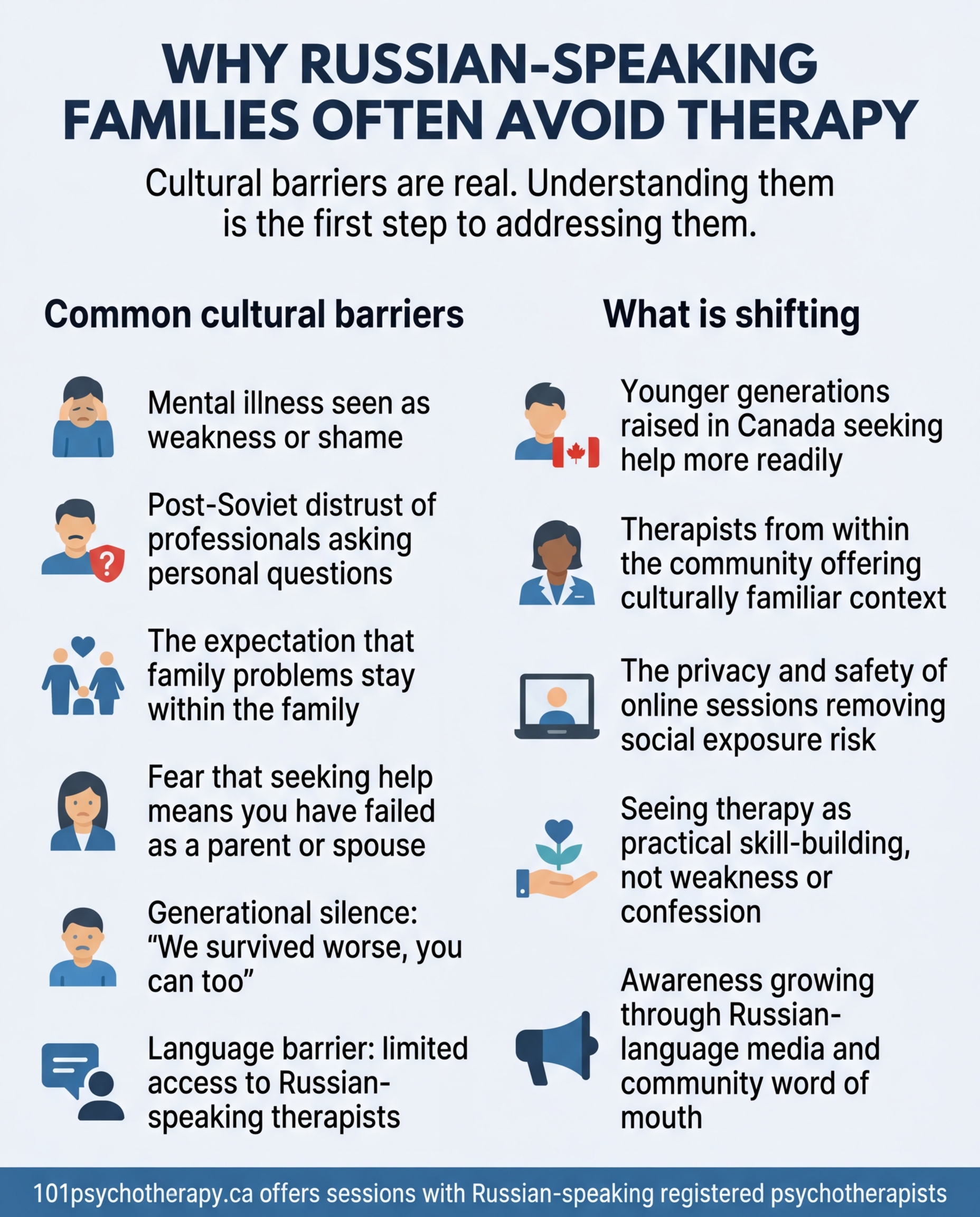
The Soviet psychiatric system was used as a tool of political control. Dissidents and non-conformists were institutionalized under psychiatric diagnoses. A mental health label could mean loss of employment, loss of rights, and permanent social stigma. The system's purpose was surveillance and compliance, not care. This history created a generational distrust of mental health professionals that is not irrational given its origins. People whose parents or grandparents lived under that system carry the memory, often without articulating it explicitly. The message was absorbed: do not expose yourself to a professional asking personal questions.

People often ask: Why do Russian-speaking families often avoid discussing mental health?
Several factors converge: mental health struggles were historically stigmatised in Soviet-era culture as signs of weakness or unreliability. Therapy was associated with Soviet-era psychiatry, which had been used as a political tool. Many families also hold strong norms around keeping private matters within the family. These patterns don't disappear in one generation.
Family privacy and the rules around disclosure
In many Eastern European families, discussing personal or family matters with an outsider, even a professional, is experienced as a form of betrayal. Family problems are family problems. They stay within the family. This value is not simply backward. It reflects genuine loyalty and a hard-won understanding that vulnerability outside the trusted circle can be costly. The problem is that it also prevents access to support that would genuinely help. The person who most needs therapy is often the one most constrained by the expectation that they should handle it alone. The generational comparison A common pattern: the older generation, who survived real hardship, dismisses psychological distress with something like: we survived far worse without therapy, you can manage this. The comparison is not wrong on its own terms. But it conflates different kinds of suffering and applies the standards of survival-level hardship to circumstances that require a different kind of response. The fact that previous generations endured more does not mean the current generation's pain is less real or less worth addressing.
Did you know?
Soviet psychiatry was formally condemned by the World Psychiatric Association in 1983 after evidence emerged that the state had used psychiatric diagnosis to detain political dissidents. This institutional misuse left a generational mistrust of mental health systems in many post-Soviet communities.

What is changing in younger generations
Adults who grew up in Canada with Russian or Eastern European backgrounds occupy a genuinely complex cultural position. They were raised with one set of values about strength, privacy, and family loyalty. They also grew up in a society where therapy is normalized, where mental health conversations happen openly, and where seeking help is framed as self-awareness rather than weakness. Many of them are quietly navigating both. They seek therapy without necessarily telling their parents. They are the bridge generation, and they are changing the cultural conversation within their own families, often by example. Online therapy has been particularly significant for this group. The option to attend sessions from home removes the fear of being seen walking into a therapy office in a community where everyone knows everyone.
Finding a therapist who understands the context
Working with a therapist who shares your cultural background or understands it changes the texture of the work meaningfully. You do not have to explain what it meant in your family to show emotion, or what was expected of you as the oldest child, or why the idea of talking to a stranger felt almost transgressive. Context that would take months to build with someone who has no frame of reference is already present. That matters.
Several of our therapists at 101 Psychotherapy have Russian-speaking backgrounds and work with clients navigating Eastern European family dynamics and cultural identity. Sessions are available in English and Russian, in-person in Vaughan and online across Ontario. Book a free consultation.
Frequently asked questions
Do you have therapists who speak Russian at 101 Psychotherapy?
Yes. Several of our therapists have Russian-speaking backgrounds and can conduct sessions in Russian or understand the cultural context you bring. You do not need to explain the cultural framing from scratch. Book a consultation and let us know your language preference.
Is it normal to feel guilty about seeking therapy as a Russian-speaking person?
Yes, and it is understandable given the cultural history. The guilt usually reflects internalized messaging about strength, family loyalty, and the belief that emotional struggle should be handled privately. Naming that guilt directly in therapy is often a productive starting point rather than something to overcome before beginning.
How is psychotherapy in Canada different from the Soviet-era psychiatric system?
Significantly different. Canadian psychotherapy is confidential (your therapist cannot share anything without your consent except in very narrow safety-related situations), voluntary, and focused on your wellbeing rather than compliance or diagnosis for institutional purposes. A therapist is not reporting to anyone about you. Understanding this distinction matters for people whose families carry distrust of mental health professionals.
How do I convince a Russian-speaking parent or grandparent that therapy is okay?
Direct persuasion usually fails because the objection is rooted in deep cultural values, not lack of information. What tends to work better: normalizing by example (sharing that someone they respect sought help), framing therapy as practical skills for managing stress (not emotional weakness), and acknowledging their perspective rather than dismissing it. Change across generations is slow but real.
What if I grew up between Russian and Canadian culture and feel I do not fully belong in either?
This experience, often called third culture or bicultural identity, is a distinct and meaningful source of stress in its own right. Feeling like you are translating between two value systems, two sets of expectations, and two selves is genuinely tiring. This is something therapy can address directly, and a therapist with cultural awareness will understand the context without needing extensive explanation.
Download the free guide
Save this as a free PDF guide.

Written by
Elena Nagovitsina
Registered Psychotherapist
Anxiety therapy, Cognitive Behavioural Therapy (CBT), Holistic Approach, Emotional Distress Therapy
