
Construction sites and workshops are usually places where things get built, but they are also places where people quietly fall apart.
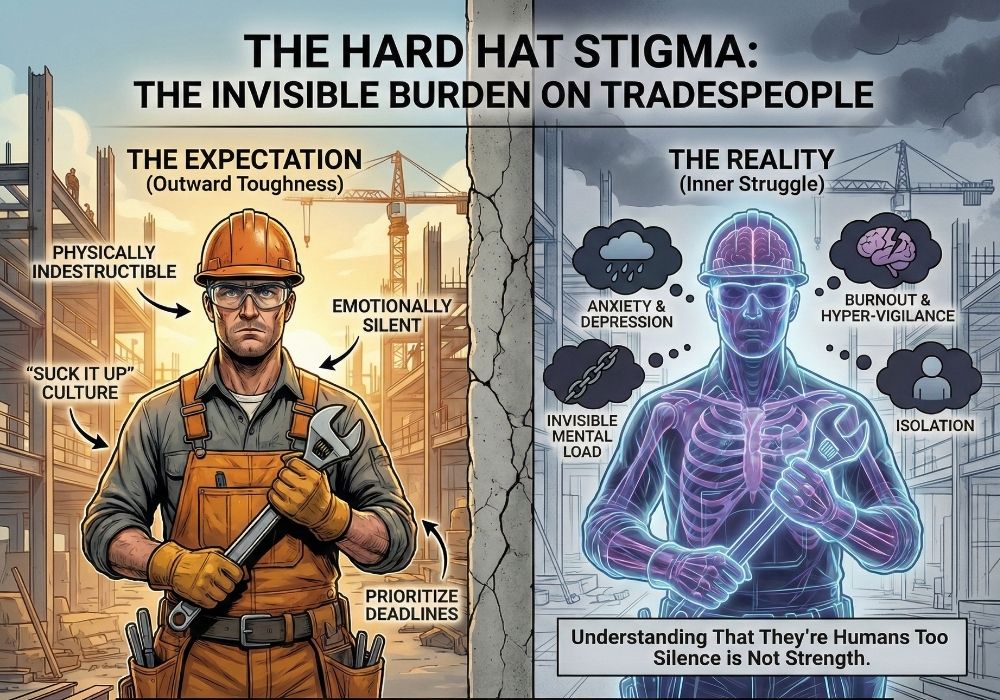
We see it all the time at 101 Psychotherapy. There is a specific kind of pressure that comes with being a tradesperson, you are expected to be physic ally indestructible and emotionally silent. This “hard hat” mentality suggests that if you can swing a hammer or weld a pipe, you should be able to handle any mental burden without flinching. It’s a dangerous standard that ignores the mental health for tradespeople, understanding that they’re humans too.
In this article
Why Mental Health is Often Ignored
The culture in the trades is built on toughness. You show up early, you work through the pain, and you get the job done. While that grit is great for meeting deadlines, it creates a massive barrier when someone is struggling with depression or anxiety. Talking about your feelings feels like a liability in an environment that prizes stoicism. We’ve noticed that mental health for tradespeople often takes a backseat to physical safety because you can see a broken arm, but you can’t see a broken spirit.
Ignoring these internal struggles doesn’t make them go away, it just makes them heavier. When you spend ten hours a day in a high-stress, high-stakes environment, your brain stays in a state of hyper-vigilance. Over time, that constant alertness wears down your resilience. If the industry doesn’t start prioritizing your mental well-being, we are going to keep losing good workers to burnout.
The link between chronic pain and mental state
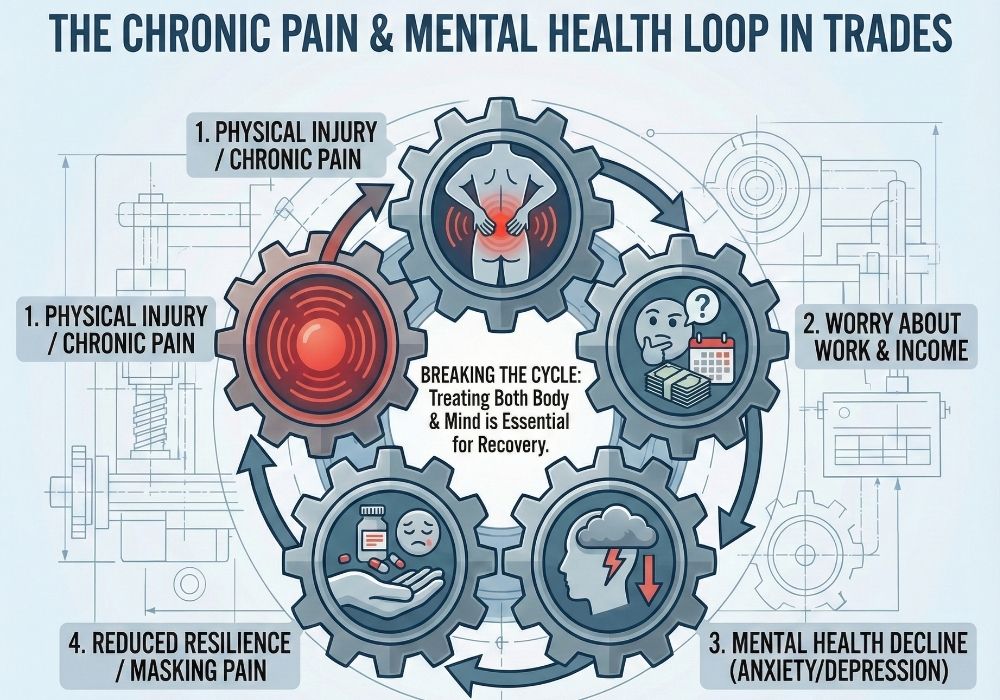
It is hard to have a positive outlook when your back hurts every single morning. Chronic physical pain is one of the biggest drivers of mental health decline in the industry. There is a direct feedback loop between a physical injury and a depressive episode. When you’re hurt, you worry about your paycheck, your ability to provide, and your long-term career. That’s a lot of weight to carry.
At our clinic, we focus on how mental health for tradespeople is tied to this physical reality. If you are masking pain with painkillers just to get through a shift, you are essentially numbing your brain’s warning lights. Eventually, the engine is going to seize. Dealing with the psychological side of injury recovery is just as important as the physical therapy. You have to address the fear of “what happens if I can’t work” before it turns into a paralyzing anxiety that affects your performance on the site.
If you’re not sure where to start with getting over this mental hurdle, let our psychotherapists help you. Our team has the experience of treating anxious thoughts through therapy, so you can fully recover both physically and psychologically.
Dealing with the “Suck it Up” culture
People often ask: How common is mental illness in the construction industry?
Construction and trades have significantly elevated rates of depression, anxiety, and substance use compared to the general population. Suicide rates in the skilled trades are among the highest of any industry, at roughly two to five times the national average depending on the sector. This is not a niche issue, it is a widespread, underaddressed public health concern.
Most guys grew up being told that real men don’t complain. This translates into a worksite culture where silence is the default. But silence is where resentment and isolation grow. We want to change the narrative. Real strength is actually the ability to admit when the load is too heavy. If you saw a coworker struggling with a beam that was too heavy for one person, you’d jump in to help. Mental health should be treated with that same level of teamwork.
Prioritizing mental health for tradespeople means acknowledging that the job is grueling. It’s loud, it’s hot or freezing cold, and the stakes are high. You are allowed to be affected by that. The “suck it up” attitude is actually a weakness because it prevents problems from being solved until they become catastrophes. We advocate for a culture where checking in on a buddy’s mental state is just as routine as checking their harness before they go up on a roof.
The impact of isolation and long hours
The trades often involve long commutes and weeks away from home on remote jobs. This isolation is a breeding ground for mental health issues. When you’re away from your support system, your partner, your kids, your friends, you lose your anchor. You’re left alone with your thoughts after a long, exhausting shift, and that’s when the darkness usually creeps in.
We see a lot of people in the industry who feel like they are just a paycheck to their families and a pair of hands to their bosses. You need to feel like a whole person, not just a labor unit. Finding ways to stay connected and finding meaning outside of the trade is vital.
Practical steps for a healthier shop floor
Did you know?
According to data from the Centre for Addiction and Mental Health (CAMH), men are four times more likely than women to die by suicide in Canada, and men in physically demanding industries face compounded stigma that delays help-seeking. The problem is not that tradespeople are less resilient, it is that the culture discourages reaching out.
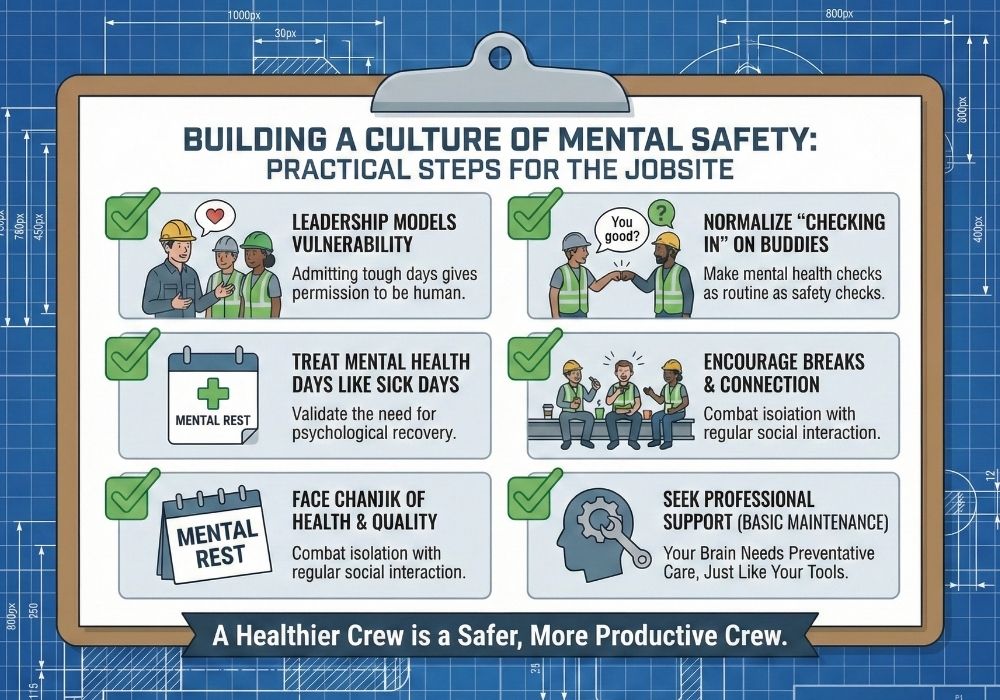
We don’t expect construction sites to turn into therapy circles overnight. That’s not realistic. But we can start with small, practical shifts. It starts with the leadership. When a foreman or a business owner admits they’re having a rough week, it gives everyone else permission to be human. Mental health for tradespeople becomes a real priority only when it is modeled from the top down.
- Stop using “mental” or “crazy” as insults on the job.
- Encourage guys to actually take their breaks instead of working through them.
- Normalize the idea of seeing a professional to talk through stress.
- Treat mental health days with the same validity as sick days.
These aren’t radical ideas. They are basic maintenance. You wouldn’t run a piece of heavy machinery for years without an oil change or a tune-up. Your brain needs that same level of preventative care. If you wait until the smoke is coming out of the ears, the repair is going to be a lot more expensive and time-consuming.
Breaking the cycle for the next generation
The younger guys entering the trades right now are watching the older generation. They are learning how to handle stress by observing the veterans. If they see the older guys burning out and turning to unhealthy coping mechanisms, they will follow suit. We have an opportunity to break that cycle. By making mental health for tradespeople a standard part of the conversation, we are protecting the future of the industry.
We want the next generation of electricians, plumbers, and carpenters to have long, fulfilling careers. That only happens if they are taught how to manage the mental toll of the job alongside the technical skills. At 101 Psychotherapy, we are committed to being a resource for the people who build our world. You spend your life making sure things are level and square, let us help you do the same for your internal world.
Frequently asked questions
Why is mental health stigma stronger in trades and construction?
Trades culture has historically valued stoicism, physical toughness, and pushing through discomfort as core professional identities. Showing vulnerability has been seen as weakness, and this gets reinforced daily on job sites through language, culture, and unspoken expectations. It is not a reflection of tradespeople as people, it is a reflection of an industry culture that has rarely made space for anything else.
What are the most common mental health challenges for tradespeople?
Depression, anxiety, and substance use are disproportionately common in trades and construction compared to the general workforce. Chronic physical pain from injuries often co-occurs with depression. Job insecurity, long hours, physical fatigue, and isolation on remote sites also contribute significantly.
How do I encourage a coworker to seek mental health support?
You do not need to have a clinical conversation. Often the most effective thing is simple: say you noticed they seem worn down, ask how they are doing, and actually wait for the answer. If they open up, listening without judgment goes further than advice. If you are concerned about their safety, be direct, asking someone directly does not plant the idea, it opens a door.
Can online therapy work for people with irregular schedules or remote sites?
Yes, and this is one area where online therapy has a genuine practical advantage. Evening, weekend, and early morning sessions are widely available, which makes consistent care possible even with rotating shifts or multi-week remote assignments. Video or phone sessions also remove the transportation barrier for those in less urban areas.
