

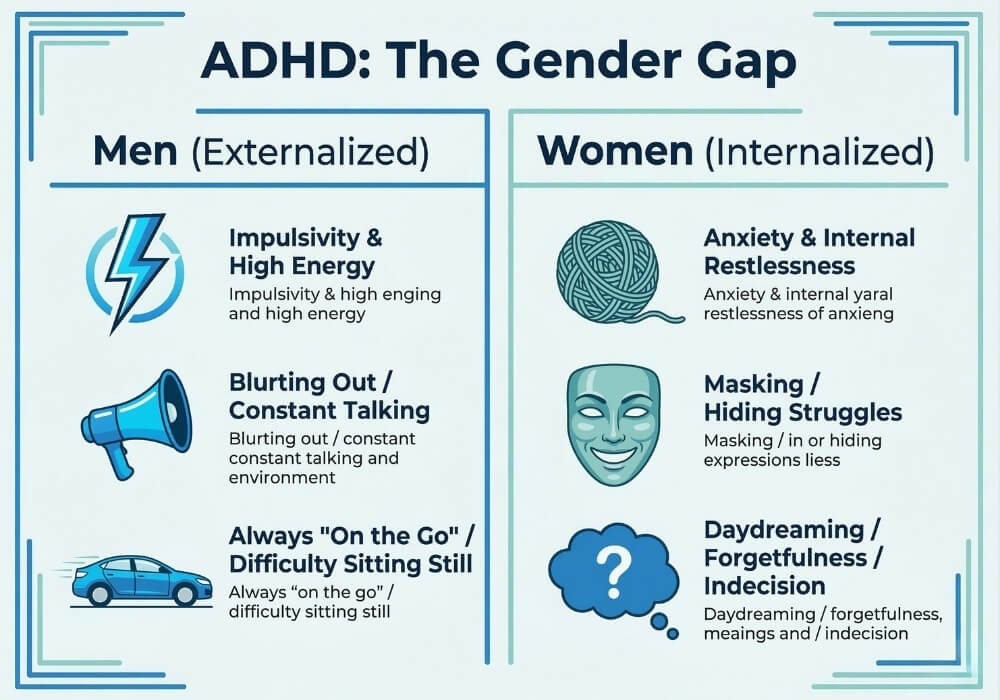
ADHD signs in men vs women differ primarily in how they are expressed outwardly. Men often display externalized symptoms like physical hyperactivity, impulsivity, and disruptive behavior, leading to earlier diagnosis. In contrast, women frequently exhibit internalized symptoms such as chronic daydreaming, emotional dysregulation, and “masking” to fit social expectations, which often results in a later diagnosis in adulthood.
In this article
- Why are ADHD symptoms often misunderstood across genders?
- What are the primary symptoms of ADHD in men?
- How do ADHD signs in women differ from men?
- Why is ADHD often diagnosed later in women?
- What are the long term effects of undiagnosed ADHD?
- How does ADHD impact relationships for men and women?
- What are the best treatment options for ADHD?
- How can you start managing your symptoms today?
- Final Verdict on ADHD signs in men vs women
- Frequently asked questions
Why are ADHD symptoms often misunderstood across genders?
For decades, the medical community viewed ADHD through a narrow lens. Most research was based on young boys who couldn’t sit still in a classroom.
This created a lasting stereotype. We expect someone with ADHD to be climbing the walls or constantly interrupting others.
While some people do fit that description, many others struggle in silence. Because women often internalize their struggles, they are frequently misdiagnosed with anxiety or depression instead of ADHD.
What are the primary symptoms of ADHD in men?
When analyzing ADHD signs in men vs women, the symptoms in men often align with the “Hyperactive-Impulsive” presentation. This is the version of the condition most people recognize immediately.
Men may feel a constant internal motor that never shuts off. This leads to physical restlessness or a need to always be doing something with their hands.
- Risk-taking behavior: This might look like reckless driving or impulsive financial decisions.
- Externalized frustration: Men with ADHD may have a “short fuse” or struggle with sudden outbursts of anger.
- Focusing on “Interesting” tasks: They might hyper-focus on a hobby for ten hours while ignoring a pile of laundry or a work deadline.
Because these behaviors are visible, men are more likely to receive support earlier in life. You can learn more about how psychotherapy can help with ADHD symptoms on our dedicated services page.
How do ADHD signs in women differ from men?
People often ask: At what age is ADHD most commonly diagnosed in women?
Women are most commonly diagnosed in their late 20s to early 40s, often triggered by a major life transition that outstrips their coping strategies: a demanding new job, having children, or losing the structured environment that helped them manage symptoms in school. Some women pursue assessment after their own child is identified as having ADHD.
Women are more likely to present with the “Inattentive” type of ADHD. Instead of being disruptive, they might be described as “quietly struggling.”
Societal expectations play a massive role here. From a young age, girls are often taught to be polite, organized, and observant of others’ feelings.
To cope, many women develop “masking” strategies. They work twice as hard to appear organized while feeling completely overwhelmed on the inside.
| Common Signs in Women | How It Impacts Daily Life |
|---|---|
| Internalized Restlessness | Racing thoughts, insomnia, or constant mental chatter. |
| Social Masking | Exhaustion from trying to act “normal” in social or work settings. |
| Emotional Dysregulation | Feeling deeply wounded by minor criticism (Rejection Sensitive Dysphoria). |
| Chronic Overwhelm | Feeling like simple household tasks are an insurmountable mountain. |

Why is ADHD often diagnosed later in women?
The gender gap in diagnosis is significant. Many women don’t realize they have ADHD until their children are diagnosed or until they hit a major life transition.
Hormonal changes can also make symptoms more obvious. Research shows that fluctuating estrogen levels can impact dopamine, making ADHD symptoms feel much worse during certain times of the month or during menopause.
When a woman reaches out for help, her symptoms are sometimes dismissed as “mom brain” or general stress. This leads to a cycle of shame and self-blame.
What are the long term effects of undiagnosed ADHD?
Did you know?
Studies suggest that girls with ADHD are referred for evaluation at much lower rates than boys with similar symptom severity. When they are referred, they are more likely to receive an anxiety diagnosis than an ADHD diagnosis, even when ADHD better explains the full clinical picture.
Living with undiagnosed ADHD is exhausting. It often leads to a specific type of burnout that doesn’t go away with a weekend of rest.
If you feel like you are constantly failing despite your best efforts, it takes a toll on your self-esteem. You might start to believe you are “lazy” or “incompetent” when your brain just functions differently.
This chronic stress often manifests as physical symptoms. Many of our clients seek help with work burnout only to discover that ADHD was the underlying driver of their fatigue.
How does ADHD impact relationships for men and women?
ADHD doesn’t just happen in your own head (it affects everyone you love). The stark contrast in ADHD signs in men vs women can create specific relationship friction.
ADHD in Men and Relationships
In men, impulsivity might lead to “blurting out” hurtful things during an argument. Partners might feel like they are being ignored because the man struggles to sustain attention during long conversations.
ADHD in Women and Relationships
For women, the “mental load” of running a household is often the breaking point. Forgetting appointments or losing track of the family schedule can lead to intense guilt and conflict with a partner.
What are the best treatment options for ADHD?
The good news is that ADHD is highly treatable. Once you understand how your brain works, you can stop fighting against it and start working with it.
- Cognitive Behavioral Therapy (CBT): Helps you identify the negative thought patterns (like “I’m a failure”) and replace them with practical strategies.
- Executive Function Coaching: Learning specific tools for time management, organization, and emotional regulation.
- Mindfulness Practices: Training the brain to return to the present moment without judgment.
- Medication: When managed by a doctor, medication can help balance the neurotransmitters that ADHD affects.
At 101 Psychotherapy, we focus on a holistic approach. We want to help you build a life that accommodates your neurodivergent strengths while managing the daily hurdles.

How can you start managing your symptoms today?
The first step is moving away from shame. Whether you are a man struggling with impulsivity or a woman struggling with “brain fog,” your experiences are valid.
You don’t have to navigate this alone. Professional support can provide the clarity you need to stop feeling overwhelmed and start feeling in control of your life.
If you are ready to explore how therapy can help you manage these symptoms, we are here to support you. You can take the next step by visiting our book appointment page for a consultation with our team.
Final Verdict on ADHD signs in men vs women
While the biological roots of ADHD are the same, the outward expression is heavily influenced by gender and social expectations. For instance, while men frequently display outward hyperactivity and impulsivity, women are more likely to internalize their struggles through inattentiveness and masking. Understanding these differences is the key to getting an accurate diagnosis and effective treatment. Recognizing the unique ways ADHD signs in men vs women appear allows us to provide better care for everyone.
Frequently asked questions
Why is ADHD diagnosed so much later in women than in men?
The diagnostic criteria for ADHD were developed largely based on research with male subjects, so the presentation that historically triggered assessment was the externalizing, hyperactive type more common in boys. Girls and women tend to display internalizing symptoms, daydreaming, emotional reactivity, chronic disorganization, that are easier to miss or attribute to anxiety or personality.
What does masking mean in the context of ADHD?
Masking is the learned behavior of hiding or compensating for ADHD symptoms to meet social expectations. For women, this often looks like working much harder than peers to appear organized, suppressing impulsivity in public while exhausted internally, or using anxiety and perfectionism as a substitute for executive function. Masking is effective enough to delay diagnosis by years or decades, but it carries a significant mental health cost.
Can women have the hyperactive type of ADHD?
Yes, though hyperactivity in women often presents differently than in men. Rather than physical restlessness or disruptive behavior, it may show up as rapid speech, racing thoughts, difficulty sitting with boredom, or constant mental activity. The classic image of hyperactivity rarely matches how ADHD presents in girls and adult women.
Can therapy help someone who suspects they have undiagnosed ADHD as an adult?
Therapy can help significantly even before a formal diagnosis. It provides structure for the executive function challenges, planning, follow-through, emotional regulation, that are central to ADHD. A formal assessment from a psychologist or psychiatrist is still valuable if you want to explore medication options or need documentation for workplace accommodations.
