

In this article
The adult ADHD that was never diagnosed in childhood is one of the most underrecognized mental health realities in Canada. Thousands of adults in Ontario are managing ADHD without knowing it, explaining years of chronic disorganization, career friction, relationship strain, and relentless self-criticism as personal failures rather than a neurological difference.
Why ADHD gets missed so often until adulthood
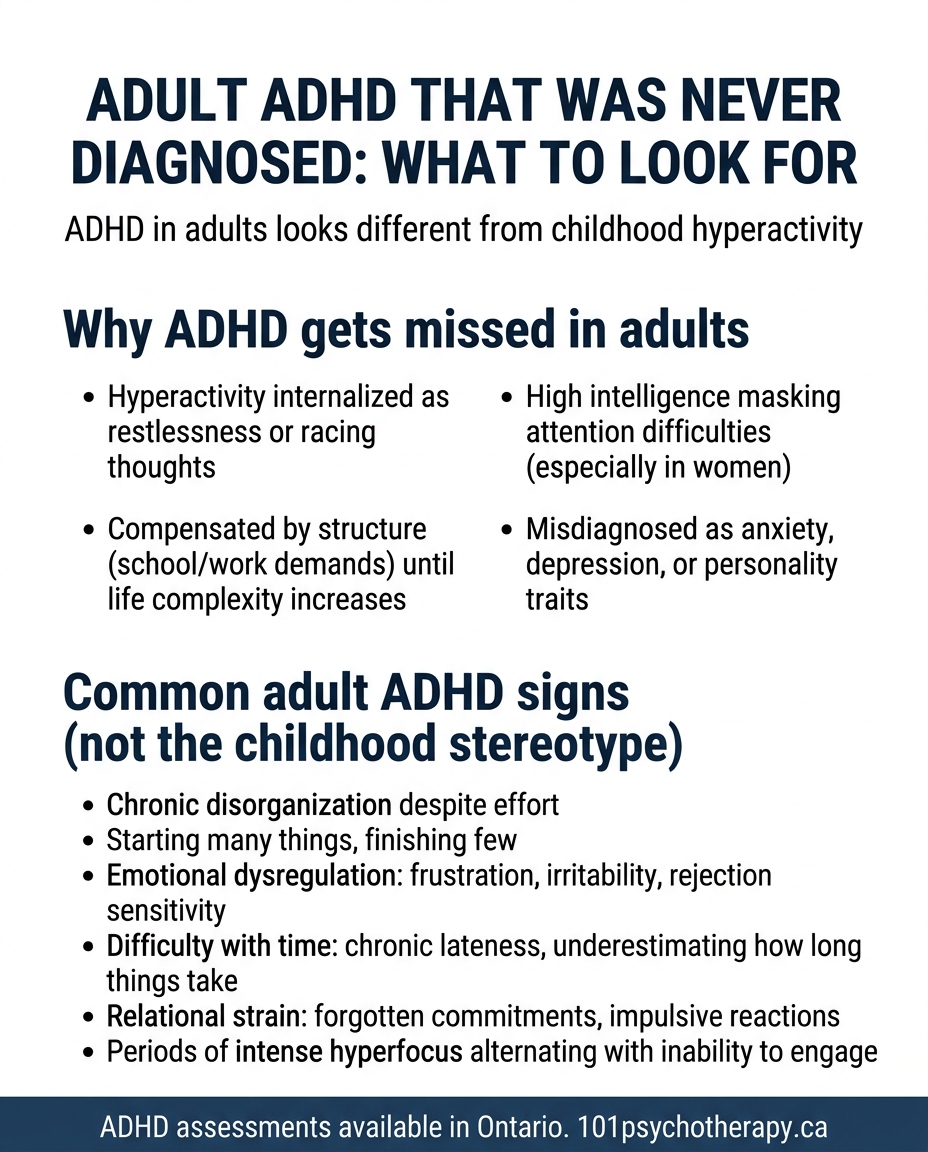
The diagnostic template for ADHD was built largely around hyperactive boys in classrooms. Girls, quieter presentations, and high-intelligence individuals simply did not fit the model. Several factors contribute to missed diagnoses: Intelligence as a compensator: High cognitive ability can mask ADHD symptoms for years. A smart person with ADHD can figure out workarounds, work harder to compensate, and appear to function well enough that the underlying difficulty never gets flagged. Until the cognitive load of adult life exceeds the capacity to compensate. Internalizing hyperactivity: Adult ADHD often looks less like physical hyperactivity and more like internal restlessness: a racing mind, an inability to sit comfortably with boredom, an almost compulsive need to be doing something. Misattribution to other conditions: The anxiety, mood instability, and self-esteem problems that often accompany ADHD get diagnosed as anxiety disorder, depression, or borderline personality disorder. The ADHD underneath stays invisible.

People often ask: Can ADHD be diagnosed in adults for the first time?
Yes. Adult ADHD diagnosis is increasingly common and well-supported by clinical guidelines. Many adults weren’t identified in childhood because they compensated effectively, had atypical presentations, or grew up before ADHD was well understood. A psychologist or psychiatrist can conduct a formal assessment at any age.
What adult ADHD actually looks like
Adult ADHD is not the classic image of a child unable to sit still. In adults, it tends to present as: Chronic disorganization: Despite genuine effort, the papers pile up, the deadlines sneak up, and the to-do lists stay unfinished. This is not laziness. It is an executive function deficit. Starting many things, completing few: New projects generate initial excitement that provides enough dopamine to get started. Sustaining attention through less stimulating phases is much harder. Time blindness: A persistent difficulty with time perception: underestimating how long things take, losing track of time entirely during absorbing tasks, chronic lateness even when you are trying hard. Emotional dysregulation: Quick frustration, intense reactions, and rejection sensitive dysphoria (an acute emotional response to perceived criticism or failure) are common but underrecognized in ADHD. Hyperfocus paradox: The same person who cannot stay engaged with a report can spend five hours immersed in a video game, a creative project, or a problem that has caught their attention. ADHD is dysregulation of attention, not simply a deficit of it.
Did you know?
ADHD affects an estimated 4 to 5 percent of adults globally, but most were not diagnosed until adulthood. Studies suggest that up to two-thirds of children with ADHD continue to meet criteria for the disorder as adults, many of whom were never identified in childhood.

The emotional cost of going undiagnosed
People who reach adulthood without an ADHD diagnosis typically carry a long history of being told they are lazy, inconsistent, flaky, or that they just need to try harder. When effort does not produce the results it produces for others, the conclusion is often internalized as a character flaw rather than recognized as a sign of a neurodevelopmental difference. Late diagnosis, when it happens, often produces a significant emotional response: relief, grief, anger at the years spent blaming yourself, and the work of rewriting a self-narrative that was built on the wrong premise.
What to do next if this resonates
Speak with your family doctor and ask for a referral for a formal assessment. In Ontario, psychologists conduct ADHD assessments that include clinical interviews and standardized measures. Private psychologists can also assess without a referral if you want a faster path. Therapy can support you regardless of whether a formal diagnosis is in place. Therapists can work on organizational strategies, emotional regulation, self-compassion, and relationship communication in the meantime.
Our therapists at 101 Psychotherapy have experience supporting adults with ADHD, late diagnosis, and co-occurring anxiety and depression across Vaughan, Richmond Hill, Aurora, and Brampton. Book a free consultation today.
Frequently asked questions
Can adults actually have ADHD if they were never diagnosed as a child?
Yes. ADHD is a neurodevelopmental condition that is present from childhood, but it often goes undiagnosed until adulthood, sometimes well into a person’s 30s or 40s. This is especially common for women, who historically received less attention from diagnostic criteria designed with hyperactive boys as the template, and for people with high intelligence who compensated through effort until adult complexity outpaced their coping.
How does ADHD in adults differ from ADHD in children?
Hyperactivity tends to be less visible in adults. Instead of running and climbing, adults often experience internal restlessness, an inability to sit still mentally, and the need to constantly be doing something. Inattentive symptoms remain prominent: difficulty sustaining focus, forgetfulness, chronic disorganization, and poor time management. Emotional dysregulation, including rejection sensitivity, is more recognized in adult presentations than in older diagnostic frameworks.
How do I get an ADHD assessment in Ontario?
A psychologist (doctoral level) can conduct a formal ADHD assessment, which includes a clinical interview, standardized rating scales, and often neuropsychological testing. To access this through OHIP, ask your family doctor for a referral to a psychiatrist or a hospital-based neuropsychology service. Private psychologists can also assess without a referral, though this is out of pocket. Wait times vary significantly.
Can therapy help with ADHD even without a formal diagnosis?
Yes. Therapists can work with adults on the challenges associated with ADHD, including organizational strategies, emotional regulation, relationship communication, and self-compassion, without a formal diagnosis in place. A diagnosis is helpful for accessing medication and certain accommodations, but it is not required to start therapy.
What does ADHD therapy look like for adults?
Common therapeutic approaches include CBT adapted for ADHD (focusing on organizational skills, time management, and managing the emotional fallout of ADHD) and DBT (which targets emotional dysregulation). Sessions tend to be practical and skills-focused. Therapy is often most effective when combined with medication, though not everyone chooses or requires medication.
Download the free guide
Save this as a free PDF guide.
