
In this article
The statistics on men and mental health are not subtle. Men account for roughly 75 percent of suicide deaths in Canada. They are significantly less likely than women to seek professional help for depression, anxiety, or stress, even when the symptoms are severe. And when they do seek help, it is often later in the deterioration than would have been ideal. Why men avoid therapy is not a mystery. The reasons are real, they are consistent across cultures and demographics, and they rarely respond to being told that men should just get over it. Here is what is actually going on, and what tends to shift things.
The real barriers men report
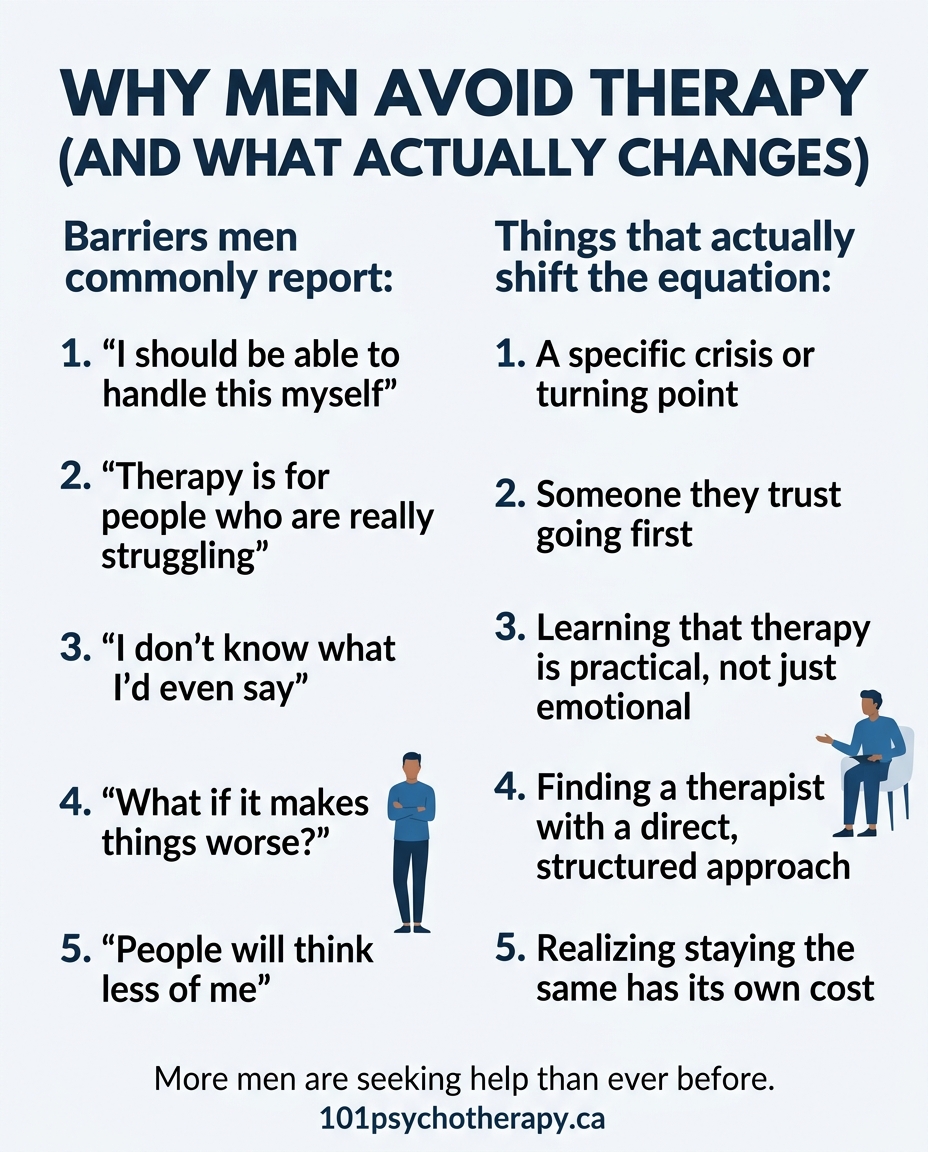
The self-reliance belief The most common and most persistent barrier: a deeply held belief that needing help means you cannot handle things yourself. This is not simply irrational. Self-reliance is a genuine value, and for many men it has been central to their identity since childhood. The problem is not the value of self-reliance but the misapplication: the idea that seeking professional help for psychological pain is somehow different from seeking medical help for a broken bone. Most men who work through this particular barrier come to see it as exactly that kind of category error.

Not knowing what therapy actually involves Many men imagine an hour of sitting in a circle talking about feelings with a stranger who says “and how does that make you feel?” a lot. The reality is considerably less daunting. CBT, which is one of the most commonly used approaches, is structured, goal-focused, and practical. Sessions tend to involve identifying specific patterns, analyzing them, and developing concrete tools. It is more problem-solving workshop than emotional excavation. Not knowing what to say A surprisingly common concern: I would not even know where to start. A skilled therapist leads the conversation. You do not need to arrive with prepared material or know how to describe what you are feeling. “Something is off and I can’t really put my finger on it” is a perfectly valid starting point.
People often ask: Is it harder for men to open up in therapy?
Many men find early sessions challenging, not because they can’t talk about emotions, but because they’ve been socially conditioned not to. Research shows that men often engage well once they have a clear sense of what therapy involves and what they’re working toward. Outcomes for men are comparable to women when engagement is sustained.
What tends to actually shift the calculation
Telling men they should seek help rarely works. What research and clinical experience both suggest is more effective: A specific crisis or turning point: Relationship breakdown, a workplace incident, a health scare, or hitting a wall after years of pushing through. A defined event makes the cost of not acting suddenly visible. Someone they respect going first: A friend, colleague, public figure, or family member being open about therapy normalizes it in a way that general public health messaging does not. One trusted person saying “I tried it and it helped” does more than a campaign. Learning the approach will suit them: Finding out that therapy can be structured and practical, not just emotionally exploratory, changes the calculation for many men who were avoiding it based on the wrong model.
Did you know?
A major systematic review found that men are 40 percent less likely than women to seek professional help for mental health concerns, yet they are overrepresented in substance use disorders and account for approximately 75 percent of deaths by suicide in Canada.

Finding a therapist that works
Fit matters significantly. A therapist with a practical, direct, structured style tends to work better for men who are initially skeptical than a more open-ended or process-oriented approach. It is reasonable to ask during a consultation: what does a typical session look like? How structured is your approach? Some therapists are much more active and directive than others. Knowing what you are getting helps. The first session does not have to be an emotional breakthrough. It just has to be useful enough that you come back for a second one.
Our therapists at 101 Psychotherapy include men with experience supporting other men through work stress, relationship challenges, and mental health concerns across Vaughan, Richmond Hill, Aurora, and Brampton. Book a free 15-minute consultation.
Frequently asked questions
Is therapy actually useful for men, or is it designed for a different audience?
Therapy works for men. The research on CBT, for example, shows comparable outcomes across genders. The question is not whether therapy is effective but whether it is delivered in a way that works for a specific person. A practical, structured, goal-focused therapist tends to be a better fit for men who are initially skeptical than a highly process-oriented or emotion-focused approach.
What should a man expect in the first few sessions of therapy?
A well-matched first session involves the therapist asking about what brought you in, what you want to change, and some background context. It should feel more like a purposeful conversation than an emotional excavation. You will not be pushed to talk about anything you are not ready for, and you can ask directly about the approach and what to expect.
Do men benefit more from male therapists?
Some men feel more comfortable initially with a male therapist, but the research on outcomes does not strongly favor gender-matching. What matters most is the quality of the therapeutic relationship, which depends on fit, communication style, and approach rather than gender. That said, if having a male therapist lowers the barrier enough to actually start, it is worth prioritizing for the first therapist you try.
Is it true that men are getting better at seeking mental health support?
Yes, and meaningfully so. Surveys consistently show that younger generations of men report more openness to therapy and mental health conversations than previous generations. Awareness campaigns and public figures speaking openly about mental health have shifted the cultural framing. The stigma is declining, though it has not disappeared.
What if I try therapy and do not find it useful?
Give it at least 4 to 6 sessions with a single therapist before deciding. Most people find the first session or two are largely getting-to-know-you. The work tends to start deepening around session 3 or 4. If after 6 sessions it is still not producing anything useful, it is worth either raising your concerns directly with the therapist or trying someone with a different approach.
Download the free guide
Save this as a free PDF guide.

Written by
Alex Kazmin
Registered Psychotherapist
CBT approach, DBT techniques, Gestalt therapy, Existential Therapy, and a holistic attitude
