
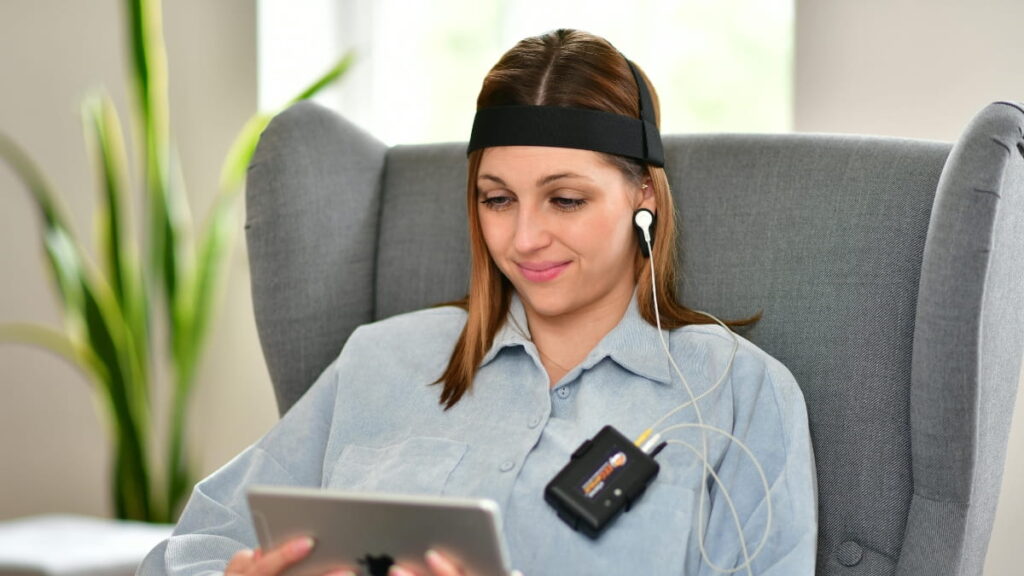
Neurofeedback therapy is offered across Ontario as a drug-free way to work on attention, restlessness, worry and sleep, and anyone who researches it for more than ten minutes runs into two flatly contradictory stories. One says it is a well-established treatment with decades of clinical use behind it. The other says the research collapses the moment you look at it closely. Both stories are told in good faith by people who have read the literature. The reason they disagree is not a mystery, and it is not a matter of opinion: it comes down to who was doing the measuring. That single methodological detail explains almost everything about why this field looks the way it does, and it is worth understanding before you spend money or months on any brain training programme.
In this article
- What Neurofeedback Therapy Actually Is
- How Neurofeedback Works
- What the Evidence Actually Shows
- Is Neurofeedback Safe?
- qEEG and Attention Testing: Assessment, Not Diagnosis
- The Main Types of Neurofeedback
- How Neurofeedback Compares With Other Approaches
- At-Home Neurofeedback Devices
- Coverage and Regulation in Ontario
- How to Decide Whether Neurofeedback Is Worth Trying
- References
What Neurofeedback Therapy Actually Is
Neurofeedback therapy is a form of biofeedback applied to the brain. Small sensors rest on the scalp and read the electrical activity your brain produces continuously. Software converts that signal into something you can see or hear, often a game, a film that brightens and dims, or a tone. When your brain activity moves toward a target pattern, the feedback rewards it. When it drifts, the feedback quietly fades.
The sensors only listen. Nothing is sent into your head, there is no current and no shock, which is why the method is described as non-invasive. You will also see it called EEG biofeedback or neurotherapy, and for practical purposes these refer to the same family of methods. If you want the clinical detail of how a course of neurofeedback therapy at our Vaughan clinic is structured, that is set out separately. What follows here is the evidence.
How Neurofeedback Works
How neurofeedback works is best understood as a loop rather than a treatment that is administered to you. First the system measures your brain activity. Then it converts that measurement into feedback within a fraction of a second. Then it rewards activity that moves toward the target. Repeat that loop several hundred times in a session, and several thousand times over a course, and the claim is that the brain gradually learns to produce the target pattern more readily on its own.
The mechanism being proposed is operant conditioning, the same learning principle behind any behaviour that becomes more frequent because it is reliably rewarded. That is a specific and testable claim, and it matters for a reason that becomes important later: if neurofeedback works through learning, the effect should show up regardless of who is watching. Note also that the brain is doing the work. Nobody can make your brain produce a pattern, which is why practitioners talk about training rather than treatment, and why change is gradual and varies between individuals.
What Brainwaves Are, and What They Are Not
Brain waves are the rhythmic electrical activity produced by populations of neurons firing together, and they are conventionally sorted into frequency bands: delta (roughly 0.5 to 4 Hz), theta (4 to 8 Hz), alpha waves (8 to 12 Hz), beta waves (12 to 30 Hz) and gamma (above 30 Hz). Neurofeedback protocols typically aim to increase activity in one band, decrease it in another, or shift the ratio between two.
It is worth being precise about what these bands are, because marketing routinely overstates it. A frequency band is a descriptive summary of electrical activity measured at the scalp, averaged across large populations of neurons and filtered through skull and tissue. It is not a readout of a thought, a mood or a personality trait, and no band is inherently good or bad. Alpha activity is not “the relaxation wave” and beta activity is not “the anxiety wave”, however often you see them labelled that way. Brainwave patterns overlap heavily between people who share a diagnosis and people who do not, which is precisely why a brain recording cannot diagnose anything.
What the Evidence Actually Shows
Does neurofeedback work? This is where the two contradictory stories come from, and the honest answer requires looking at how the studies were built rather than at what their abstracts conclude. The pattern that emerges is consistent, striking, and rarely mentioned on clinic websites.
The Largest Analysis to Date Found No Benefit at the Group Level
The most comprehensive assessment of neurofeedback for ADHD was published in JAMA Psychiatry in 2025 by Westwood and colleagues, working with the European ADHD Guidelines Group. It pooled 38 randomised controlled trials covering 2,472 participants aged 5 to 40, which makes it substantially larger than anything before it.
Its conclusion was blunt. The authors wrote that “after decades of research, we found no group-level evidence supporting neurofeedback as a stand-alone treatment for ADHD”, and that neurofeedback “did not appear to meaningfully benefit individuals with ADHD, clinically or neuropsychologically, at the group level”. When the analysis was restricted to raters who were probably blinded to who had received real training and who had received sham, the effect on total ADHD symptoms was a standardised mean difference of 0.04, with a confidence interval running from -0.10 to 0.18. That interval comfortably includes zero. In the same analysis, methylphenidate outperformed neurofeedback.
This is one systematic review, not a final verdict, and pooling trials of varying quality has its own limitations. But it is the largest and most rigorously blinded synthesis available, and any honest account of neurofeedback has to start with it rather than bury it.
Why Blinding Changes the Answer
Here is the finding that explains the whole field. In that same 2025 analysis, when the outcome was rated by people who were not blinded, typically parents who knew whether their child had been receiving real neurofeedback, the effect sizes ranged from 0.26 to 0.36. When the outcome was rated by people who were probably blinded, the effect fell to 0.04. The treatment did not change. The rater did.
It is important to be fair about what this does and does not mean. It does not mean parents were lying, or that clinicians are running a con, or that people who felt better were imagining it. Expectation genuinely shapes what we notice and how we score it, and that is true of everyone, including experts, including me. A parent who has driven their child to forty appointments, paid for them, and watched them concentrate on a screen twice a week is not a neutral observer of whether that child is now calmer. Nobody would be. Blinding exists precisely because human observation is unreliable in this specific, predictable way, and the gap between 0.36 and 0.04 measures exactly how unreliable.
This also explains why neurofeedback reviews and testimonials are so consistently positive while the controlled trials are not. Both are telling the truth about what they measured. They are just measuring different things.
Where a Signal May Still Survive
Neurofeedback benefits are not zero everywhere in the data, and it would be dishonest to imply otherwise. The 2025 analysis found one subgroup where a small effect survived blinding: when trials were restricted to established standard protocols, blinded ratings of total symptoms showed a standardised mean difference of 0.21, with a confidence interval of 0.02 to 0.40. It is statistically significant. The authors themselves, however, immediately noted that an effect of that size “likely falls short of clinical value”, and that it did not appear when inattention and hyperactivity were examined separately. A second signal appeared for processing speed, at 0.35, which the authors described as barely significant with significant heterogeneity. Longer-term effects at six to twelve months were not found except, again, for processing speed.
You will also encounter a frequently cited 2019 review in Current Psychiatry Reports concluding that neurofeedback based on standard protocols “should be considered as a viable treatment alternative” for ADHD. That review is real and its authors are serious researchers, but two things should be said about it. It predates the 2025 analysis, which examined the same question with more trials and stricter attention to blinding. And two of its four authors declare commercial interests in neurofeedback, including stock in and a scientific advisory role at a neurofeedback company. That does not make the review wrong, but it is something a reader is entitled to know, and it is almost never disclosed when the review is quoted.
What the Evidence Looks Like Beyond ADHD
Neurofeedback for anxiety has the weakest evidence base of the conditions commonly advertised. A large share of the published studies are single-group before-and-after designs with no control condition, which cannot separate the training from the passage of time, from regression to the mean, or from the experience of attending a calm room weekly and being taken seriously by a clinician.
Neurofeedback for depression is a little better studied but still thin. A 2022 meta-analysis in Psychological Medicine reached a positive conclusion, reporting that “heart rate variability (HRV) biofeedback and neurofeedback are associated with a reduction in self-reported depression” and describing the approach as promising. Its authors were candid about the caveats: they noted that “the risk of bias was high or unclear in the majority of the studies”, and the analysis pooled heart rate variability biofeedback together with neurofeedback, so it is not a clean measure of neurofeedback on its own. Its outcomes were also self-reported, which returns us to the blinding problem. Read fairly, it is an encouraging finding resting on a thin and uneven evidence base.
Neurofeedback for PTSD and trauma has produced the most encouraging controlled result in this literature, and it is worth reading carefully rather than quickly. A 2023 double-blind randomised trial published in Brain Communications, from a team including researchers at Western University and the University of Ottawa, delivered 20 sessions of alpha desynchronising neurofeedback against a sham condition. At three-month follow-up, 60.0% of participants in the active group no longer met diagnostic criteria for PTSD, compared with 33.3% of those in the sham group. That contrast looks impressive, and you will see it quoted on its own. What usually goes unquoted is that the trial randomised 38 people, and that the direct statistical comparison between the active and sham groups did not reach significance at either post-treatment or follow-up. The remission figures are descriptive. So this is a genuinely promising early signal from a small trial, not a demonstration that neurofeedback beat the sham, and it needs replication at scale before anyone leans on it.
The recurring pattern across every condition is the same: the more carefully a trial controls for expectation, the smaller the effect becomes. That pattern is itself informative.
Is Neurofeedback Safe?
Is neurofeedback safe? On the available evidence, it appears to be low-risk. The sensors are passive, no energy is delivered to the brain, and the most rigorous trials have not turned up serious harms. The 2022 double-blind trial in the American Journal of Psychiatry, which randomised 88 boys with ADHD, reported that “there were no significant side effects or adverse events”. Neurofeedback is not going to damage your brain, and there is no plausible mechanism by which it could.
But you should know how weak the safety data actually are, because almost nobody says this out loud. You will find a figure circulating widely on clinic websites claiming that side effects occur in roughly 1 to 3 percent of patients and resolve within 24 to 48 hours. I am not going to repeat those numbers as fact, because I could not trace them to any peer-reviewed source. The most relevant review of adverse effects, Hurt and colleagues in 2014, states the opposite: “there are no published studies that focus specifically on the adverse effects of NF, either in adults or in youth. There are no systematically collected data on their frequency, severity, or duration.” The 2025 JAMA Psychiatry analysis noted that the trials it pooled did not consider iatrogenic effects at all.
What can be said honestly is this. Transient tiredness, headache, or feeling briefly wired or irritable after a session are reported anecdotally and are what clinicians watch for. A 2015 sham-controlled study found that most of its participants reported some side effects, though it studied 30 healthy university students rather than a clinical population. The reasonable summary is that neurofeedback appears low-risk, that no one has properly measured how often mild effects occur, and that “no evidence of harm” is not the same statement as “evidence of no harm”. A practitioner who quotes you a side effect rate to one decimal place is quoting something that does not exist.
qEEG and Attention Testing: Assessment, Not Diagnosis
qEEG brain mapping, short for quantitative EEG, is a recording of your brainwave activity that is processed statistically and often compared against a reference database, then presented as a colour-coded map of the head. Brain mapping of this kind is widely used to select a neurofeedback protocol and, more defensibly, to establish a baseline so that change can be tracked rather than guessed at.
What a qEEG cannot do is diagnose anything, and on this the Canadian guidance is unambiguous. The Canadian ADHD Resource Alliance, whose practice guidelines are the standard Canadian reference, states that “EEG testing Is [sic] not a validated diagnostic tool for ADHD and CADDRA does not endorse its use for this purpose”. If a clinic offers you a brain map that will tell you whether you have ADHD, that offer is not supported by Canadian practice guidelines. The same caution applies to computerised attention tests such as the T.O.V.A.: they measure aspects of attention performance under standardised conditions, which is useful information, but a test score is not a diagnosis.
This distinction is not academic in Ontario, it is a matter of regulated scope. The College of Registered Psychotherapists of Ontario is explicit that its registrants “are not authorized to communicate a diagnosis to clients; however, they are permitted to assess clients”, and it draws the line clearly: “[a] diagnosis is a conclusive statement that identifies a disease or disorder as the cause of a client’s symptoms. An assessment describes those symptoms and is aimed toward treatment planning.” A formal diagnosis in Ontario comes from a physician or a psychologist. At 101 Psychotherapy we work in assessment and symptom terms, which is why any attention assessment we use serves to establish a baseline and inform an ADHD therapy plan, never to label you. If you are trying to make sense of your own attention patterns, it may help to read about how ADHD presents differently in men and women first.
The Main Types of Neurofeedback
Types of neurofeedback fall into a few broad families, and knowing the vocabulary is useful because the differences between them matter more than the marketing suggests. Frequency band training, which includes SMR training and theta/beta ratio protocols, is the oldest and most studied approach, and it works by rewarding a shift in the balance between bands. Slow cortical potential training targets slow shifts in cortical electrical activity rather than frequency bands. Alpha-theta training, often used in trauma and addiction contexts, aims at a deeply relaxed state near the edge of sleep. LORETA neurofeedback attempts to target activity localised to deeper brain regions rather than the scalp surface.
Alongside these sit a number of proprietary branded systems, including NeurOptimal and its dynamical neurofeedback approach, LENS, and various microcurrent neurofeedback systems. Here is the point that is easy to miss: in the 2025 JAMA Psychiatry analysis, the only category where any effect survived blinding was established standard protocols. The proprietary systems are not the better-evidenced ones. They are generally the less-evidenced ones, and some depart substantially from the operant conditioning rationale described earlier. A system being patented or described as advanced tells you nothing about whether it outperforms a sham.
How Neurofeedback Compares With Other Approaches
Neurofeedback is rarely the only option on the table, and it is almost never the only option worth considering.
Neurofeedback and Biofeedback
Biofeedback versus neurofeedback is a distinction that confuses a lot of people, and the answer is simpler than it looks: neurofeedback is biofeedback. Biofeedback is the general method of measuring a bodily process you cannot normally perceive, such as heart rate variability, muscle tension, breathing or skin temperature, and showing it back to you in real time so you can learn to influence it. Neurofeedback is that same method applied to brain activity specifically. Everything else follows from that, including the fact that biofeedback for some non-psychiatric applications has a considerably firmer evidence base than neurofeedback for mental health does.
Neurofeedback and Talk Therapy
Neurofeedback versus EMDR, or versus cognitive behavioural therapy, is the comparison people most often want, and the honest answer is not the one a neurofeedback provider is commercially incentivised to give. Established psychotherapies have a substantially stronger evidence base for anxiety, depression and trauma than neurofeedback does. Cognitive behavioural therapy for anxiety and depression, and trauma-focused therapies including EMDR for PTSD, are supported by far more trials, larger samples, and, critically, better controls than the neurofeedback literature can currently offer.
That is why we regard neurofeedback as something used alongside therapy rather than instead of it, and why it is not the first thing we suggest to most people who come to us for anxiety therapy or therapy for depression. If you are choosing between talk therapy and neurofeedback for a common mental health concern, the evidence currently favours the talk therapy. That is worth saying plainly even though it is not a sales pitch.
At-Home Neurofeedback Devices
Neurofeedback at home has become a real option, and consumer devices such as Muse and similar EEG headbands are now widely sold. It is worth being clear about the gap between these and clinical systems. A consumer headband typically uses a small number of dry sensors on the forehead and ears; a clinical system uses more sensors, conductive gel, and placement chosen by a trained operator. The signal quality is not comparable, and forehead sensors are especially prone to picking up muscle activity from the eyes and jaw and treating it as brain activity.
There is also a regulatory point most device marketing avoids. In the United States, biofeedback devices sit in Class II under 21 CFR 882.5050, and prescription battery-powered units indicated for relaxation training and muscle reeducation are exempt even from premarket notification. Nothing in that pathway requires trials showing the device treats a psychiatric condition. No neurofeedback device is approved to treat any mental health condition, and using one for ADHD, anxiety or depression is off-label. A device may still be a pleasant way to practise attention or relaxation. It is not a treatment and should not be bought as one.
Coverage and Regulation in Ontario
Is neurofeedback covered by insurance in Canada? Mostly not, and the details are worth knowing before you commit to a course. Neurofeedback does not appear in the OHIP Schedule of Benefits as an insured service, and Registered Psychotherapists are not OHIP billing providers, so this is not something the provincial plan pays for. Coverage through extended health benefits varies considerably, and depends less on the treatment than on the professional designation of the person delivering it, so the only reliable move is to ask your insurer about your specific plan and your specific provider before you start.
There is one significant exception. Veterans Affairs Canada does cover neurofeedback and EEG biofeedback, and the terms of that coverage are instructive. It is approved only as an adjunct to first-line evidence-based treatment, and only for post-traumatic stress disorder, generalized anxiety disorder or major depressive disorder. It requires a clinical recommendation from the first-line treating mental health professional. The provider must hold certification from the Biofeedback Certification International Alliance, and the benefit is capped at 25 sessions per calendar year. Read that carefully: a federal payer will fund neurofeedback, but only as an add-on to a treatment that already works, never as a replacement for one. That is a coverage decision, not a declaration that the treatment is proven.
On who may practise, Ontario has less to say than you might expect. Neurofeedback is not one of the controlled acts under the Regulated Health Professions Act, which means no single profession owns it. The College of Registered Psychotherapists of Ontario includes biofeedback, of which neurofeedback is a form, in an illustrative list of somatic therapy modalities, a list it describes as not exhaustive, and it has issued no neurofeedback-specific guidance. In practice this means the equipment does not certify the operator, and you should ask about the clinician’s training and regulated status rather than about the machine.
How to Decide Whether Neurofeedback Is Worth Trying
None of the above adds up to “never try neurofeedback”. It adds up to something more useful: try it with your eyes open, and with a way of finding out whether it is working for you specifically. Group-level evidence describes averages, and you are not an average. But the reason to be careful is that a treatment with a near-zero blinded group effect is exactly the kind where you are most likely to fool yourself about your own progress.
A few questions are worth asking any provider. What is your training, and what regulated college are you accountable to? What baseline will you take before we start, and how will we measure change in a way that does not rely purely on my impression or my family’s? Which protocol are you proposing, and is it one of the established standard protocols? At what point will we review whether this is helping? And most revealing of all: under what circumstances would you tell me to stop? A provider who cannot answer that last question, or who tells you the science is settled, has told you something important.
Our own position at 101 Psychotherapy is the one this article has argued for. We use neurofeedback as one focused support within a wider psychotherapy plan rather than as a treatment in its own right, we set a baseline so that we are not guessing, we are candid about the state of the evidence, and we stop if it is not helping. If you are looking for neurofeedback therapy near you in Vaughan, Thornhill, Toronto or the surrounding area and want to work out whether it makes sense for you, the sensible first step is a conversation rather than a purchase: you can book a free initial consultation and we will give you our honest read, including if that read is that something else would serve you better.
References
- Westwood SJ, Aggensteiner PM, Kaiser A, et al. Neurofeedback for Attention-Deficit/Hyperactivity Disorder: A Systematic Review and Meta-Analysis. JAMA Psychiatry. 2025;82(2):118-129. doi:10.1001/jamapsychiatry.2024.3702. Free full text: PMC11800020
- Nicholson AA, Densmore M, Frewen PA, et al. Homeostatic normalization of alpha brain rhythms within the default-mode network and reduced symptoms in post-traumatic stress disorder following a randomized controlled trial of electroencephalogram neurofeedback. Brain Communications. 2023;5(2):fcad068. doi:10.1093/braincomms/fcad068. Free full text: PMC10090479
- Lam SL, Criaud M, Lukito S, et al. Double-Blind, Sham-Controlled Randomized Trial Testing the Efficacy of fMRI Neurofeedback on Clinical and Cognitive Measures in Children With ADHD. American Journal of Psychiatry. 2022;179(12):947-958. doi:10.1176/appi.ajp.21100999. Free full text: PMC7614456
- McGough JJ. Neurofeedback for ADHD: Time to Call It Quits? American Journal of Psychiatry. 2022;179(12):888-889. doi:10.1176/appi.ajp.20220861
- Hurt E, Arnold LE, Lofthouse N. Quantitative EEG Neurofeedback for the Treatment of Pediatric Attention-Deficit/Hyperactivity Disorder, Autism Spectrum Disorders, Learning Disorders, and Epilepsy. Child and Adolescent Psychiatric Clinics of North America. 2014;23(3):465-486. doi:10.1016/j.chc.2014.02.001
- Rogel A, Guez J, Getter N, et al. Transient Adverse Side Effects During Neurofeedback Training: A Randomized, Sham-Controlled, Double Blind Study. Applied Psychophysiology and Biofeedback. 2015;40(3):209-218. doi:10.1007/s10484-015-9289-6
- Fernandez-Alvarez J, Grassi M, Colombo D, et al. Efficacy of bio- and neurofeedback for depression: a meta-analysis. Psychological Medicine. 2022;52(2):201-216. doi:10.1017/S0033291721004396
- Enriquez-Geppert S, Smit D, Pimenta MG, Arns M. Neurofeedback as a Treatment Intervention in ADHD: Current Evidence and Practice. Current Psychiatry Reports. 2019;21(6):46. doi:10.1007/s11920-019-1021-4. Free full text: PMC6538574
- Van Doren J, Arns M, Heinrich H, et al. Sustained effects of neurofeedback in ADHD: a systematic review and meta-analysis. European Child & Adolescent Psychiatry. 2019;28(3):293-305. doi:10.1007/s00787-018-1121-4. Free full text: PMC6404655
- Marzbani H, Marateb HR, Mansourian M. Neurofeedback: A Comprehensive Review on System Design, Methodology and Clinical Applications. Basic and Clinical Neuroscience. 2016;7(2):143-158. doi:10.15412/J.BCN.03070208. Free full text: PMC4892319
- Canadian ADHD Resource Alliance (CADDRA). Canadian ADHD Practice Guidelines, 4.1 Edition. Toronto: CADDRA, 2020.
- College of Registered Psychotherapists of Ontario. Jurisprudence e-Learning Manual, Part 2: Practice Standards.
- College of Registered Psychotherapists of Ontario. Controlled Act of Psychotherapy.
- Veterans Affairs Canada / Medavie Blue Cross. Program of Choice 06, Medical Services, Mental Health Services Update: Neurofeedback/EEG Biofeedback. January 2022.
- United States Food and Drug Administration. 21 CFR 882.5050: Biofeedback device.
- Government of Ontario. Health Insurance Act, R.R.O. 1990, Regulation 552: General.

Written by