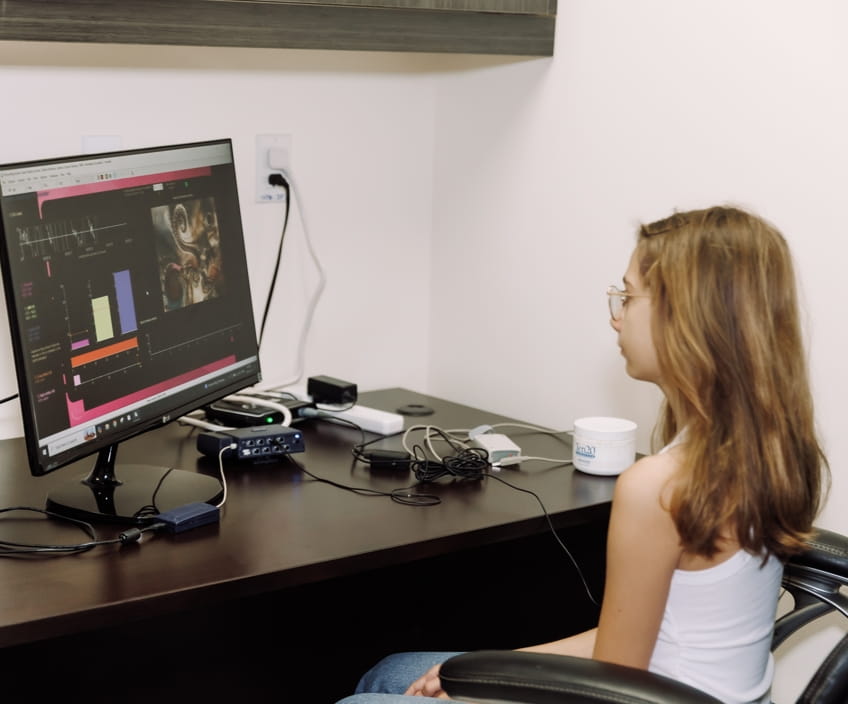
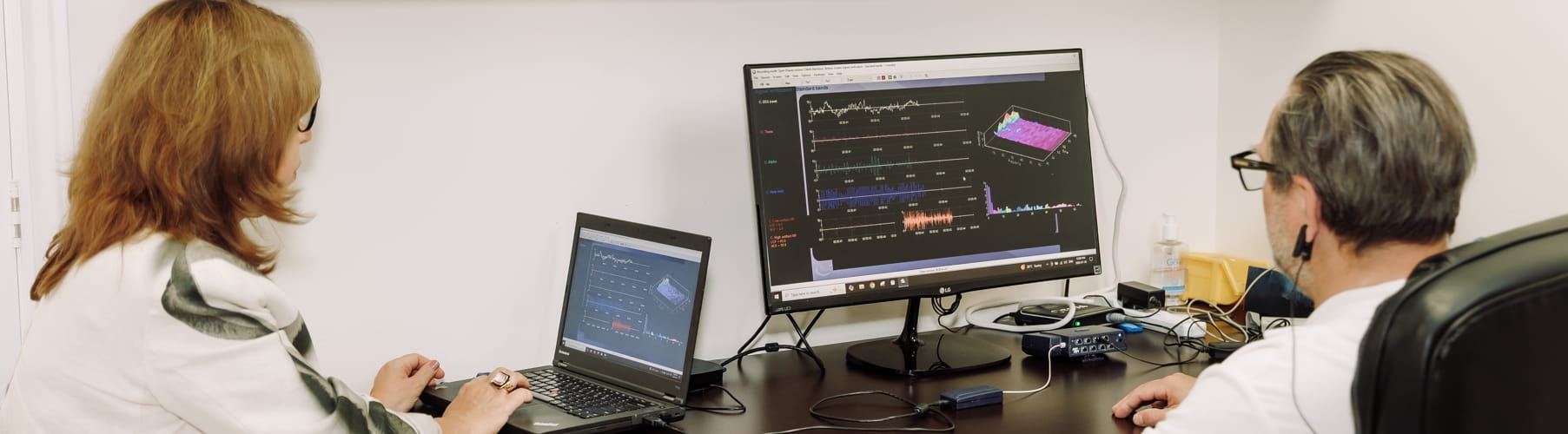
Restlessness, a mind that races, trouble winding down or holding your focus: these often sit in how the brain regulates itself, not only in how you think things through. Neurofeedback is a non-invasive, drug-free way to work at that level. Also known as EEG biofeedback, it shows your own brain activity back to you in real time so it can gradually learn calmer, steadier patterns. At 101 Psychotherapy in Vaughan, neurofeedback is led by an experienced MD and PhD clinician and tailored to you. We will always be straight with you about what it can and cannot do.
- Led by an MD/PhD clinician
- Non-invasive, drug-free brain training (EEG biofeedback)
- Used on its own or alongside talk therapy
- Sessions from $120, with a free initial consultation
What Is Neurofeedback?
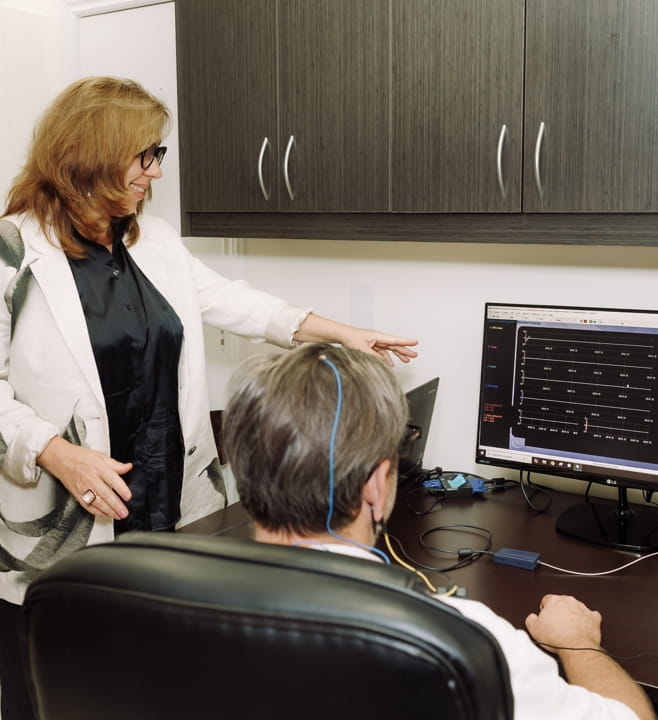
Neurofeedback is a type of biofeedback that focuses on the brain. Small sensors resting on the scalp read your brainwaves, the electrical activity your brain produces all the time, and a computer turns that signal into something you can see or hear, such as a game that plays smoothly when your brain settles into a calmer, more balanced state. Nothing is sent into your head; the sensors only listen. Across a series of sessions, the aim is that the brain, given this steady feedback, gradually gets better at self-regulating on its own. You may also see it called EEG biofeedback or neurotherapy. It is a form of brain training that can be used on its own or alongside talk therapy, depending on what you are working on.
How Neurofeedback Works
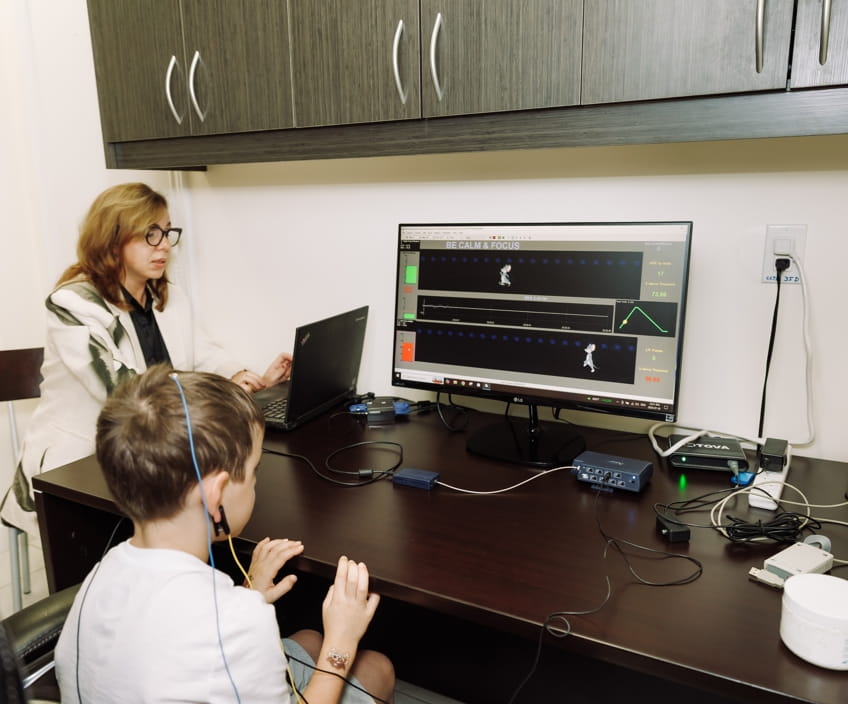
Every session runs on the same simple loop. First we look at what your brain is doing: an assessment, sometimes including a qEEG recording of your brainwave patterns, gives us a picture to work from. During a session you sit comfortably while the sensors track your activity and the software responds in real time. When your brain moves toward the target pattern the game, sound or video rewards it; when it drifts, the feedback quietly fades. Neurofeedback adds no electricity, current or shock; it only mirrors your own activity back to you. Repeated over time, this is how the brain is thought to learn to self-regulate: not by being forced, but by being encouraged toward steadier rhythms. Change tends to be gradual, and it varies from one person to the next.
What Neurofeedback Can Help With
People usually come to neurofeedback hoping to feel calmer, sleep more easily or concentrate better, and many find it a genuinely useful part of their care. We use it as one focused support within a wider plan, matched to what you are working on. It is most often used to help with:
- ADHD/ADD
- Enhanced focus, mental clarity, and learning ability
- Anxiety and everyday worry
- Low mood and depression
- Sleep problems and insomnia
- Stress and burnout
101 Psychotherapy – Always caring, always here
Can Neurofeedback Help With ADHD?
For many people, neurofeedback for ADHD becomes a valued, drug-free way to work on attention, focus and restlessness, and it has been used with ADHD for decades. At 101 Psychotherapy, our MD/PhD clinician tailors it to you and tracks your progress from a clear baseline, so you can see whether it is helping. Neurofeedback can be used on its own or as one part of a broader ADHD treatment plan, alongside assessment, psychotherapy and practical skills. The science is still developing, and we would rather be upfront than overpromise, so we will always talk you through what to expect before you begin. The best way to find out whether it suits you is a free consultation, where we can look at your goals together and shape a plan that fits.
What to Expect in a Session
We usually start with a baseline so progress can be tracked. This may include a brief attention check such as a T.O.V.A. assessment. A typical session lasts around 30 to 40 minutes: you relax while the sensors read your brainwaves and you watch or listen to the feedback. Most people find the sessions calm and low-key, which is exactly how they should feel. A course of neurofeedback treatment works gradually across a series of sessions rather than in a single visit, and we review your progress as we go, keeping what helps and adjusting what does not.
The Evidence Behind Neurofeedback
We would rather give you the real picture than a sales pitch. Neurofeedback is an active area of research, and the findings are genuinely mixed. On the encouraging side, a widely cited 2019 review in Current Psychiatry Reports concluded that, using standard protocols, neurofeedback can be a viable treatment option for ADHD. On the cautious side, a 2022 paper in the American Journal of Psychiatry questioned its role in ADHD, and a large 2025 systematic review and meta-analysis in JAMA Psychiatry found that, overall, neurofeedback did not clearly reduce core ADHD symptoms and could not be recommended as a first-line treatment. Canada’s ADHD guidelines (CADDRA) place it among approaches that still need more research before they can be recommended. As Psychology Today puts it, neurofeedback is best seen not as a cure but as a way of helping the brain regulate itself. Our approach reflects that in practice: an experienced clinician checks whether it suits you, we track your response with a baseline so we are not guessing, we pair it with therapy, and we review progress honestly, adjusting or stopping if it is not helping.
Simple, Affordable Pricing
Neurofeedback sessions start at $120, and your first step, a consultation to see whether it suits you, is free. Because a course of neurofeedback treatment works across a series of sessions rather than in a single visit, we will always be upfront about the likely number and the total cost before you commit to anything. One note on coverage: neurofeedback is not covered by OHIP, and reimbursement through extended health benefits varies by plan and by the provider’s designation, so we recommend checking directly with your insurer before you begin.
Book a Free Consultation
Meet Your Neurofeedback Specialist
Neurofeedback at 101 Psychotherapy is provided by Tatiana Dvorkina. Tatiana is a clinician with an MD and a PhD and many years of experience as a former psychiatrist, alongside published academic research. She specializes in neurofeedback and biofeedback, sometimes referred to together as neurobiofeedback (NBFB), and in TOVA-based attention assessment, which she uses to establish a clear baseline before any training begins. Her approach pairs careful, evidence-informed assessment with a calm, personalized style.
View Tatiana's ProfileVisit Our Clinic
You will find us at 1520 Steeles Avenue West #101A, Vaughan, ON L4K 3B9, in the Concord area, with easy access from Highways 400 and 407. Because neurofeedback uses equipment, the training sessions themselves take place in person at our Vaughan clinic, which is easy to reach for clients looking for neurofeedback near them in Concord, Woodbridge, Maple and Thornhill, as well as those travelling from nearby communities such as Aurora, Brampton, Markham, Mississauga, Milton, Oakville, Oshawa and Richmond Hill. We also welcome clients from across Toronto, including North York, Midtown and Uptown Toronto.
Visit us: 1520 Steeles Ave W #101A, Vaughan, ON L4K 3B9 (Steeles & Dufferin, Concord). Phone: (905) 597-2521
Frequently Asked Questions
What does neurofeedback do?
Neurofeedback reflects your own brainwave activity back to you in real time so your brain can gradually learn steadier, more balanced patterns. It is a form of EEG biofeedback used to support focus, calm and sleep. Nothing is added to your brain, as the sensors only read activity, and many people use it to complement their wider care.
Is neurofeedback covered by insurance in Canada?
It is not covered by OHIP. Some extended health plans reimburse it, but this depends on your particular plan and on the provider’s designation, so the safest step is to check with your insurer before you start.
How much does a neurofeedback session cost?
Sessions start at $120, and the first consultation is free. Because neurofeedback runs across a series of sessions, we will give you a clear sense of the likely number and total cost up front.
Are there side effects or downsides to neurofeedback?
Neurofeedback is non-invasive and generally considered low-risk. The most common report is mild, short-lived tiredness after a session, a little like after exercise. It also takes time and multiple sessions, and it may not help everyone; if anything feels off, we adjust or pause.
Is neurofeedback safe?
For most people, yes. The sensors only listen to your brain’s activity, and nothing is sent in. We screen first to make sure it is appropriate for you, and we keep an eye on how you respond throughout.
Curious Whether Neurofeedback Is Right for You?
The easiest way to find out is a free consultation. We will listen to what you are dealing with, explain honestly what neurofeedback can and cannot do, and help you choose a sensible next step, whether that is neurofeedback, therapy, or both. Book your appointment with 101 Psychotherapy in Vaughan today.